
Science
Breakthrough in Quantum Teleportation Achieved by Researchers

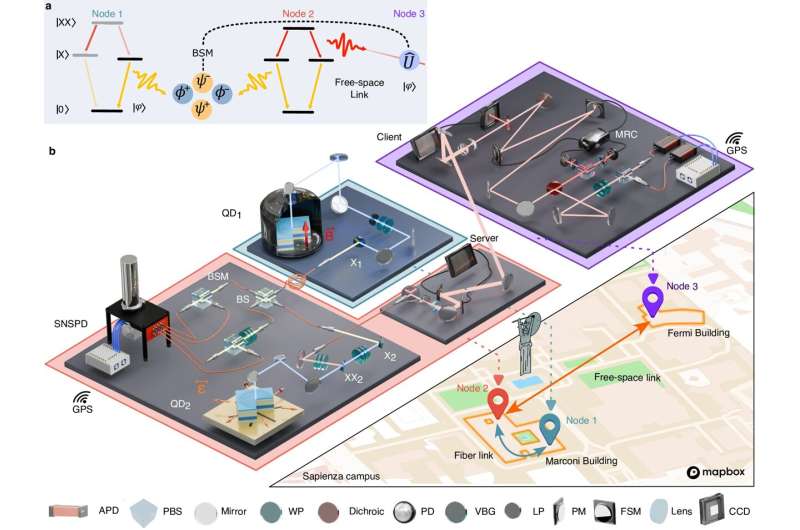
An international research team, including scientists from Paderborn University, has made significant strides towards establishing a quantum internet by successfully achieving single-photon teleportation. For the first time, the polarization state of a single photon emitted from one quantum dot has been teleported to another quantum dot located at a distance. This breakthrough represents a crucial development for future quantum communication systems.
The team conducted their experiments using a 270-meter free-space optical link, demonstrating the potential for long-distance quantum communication. The results of this work have been published in the journal Nature Communications on December 2, 2025.
Collaboration and Years of Research Pay Off
The achievement is the culmination of nearly a decade of collaborative effort among doctoral and postdoctoral students at Paderborn University. Under the guidance of Professor Klaus Jöns, the team partnered with Professor Rinaldo Trotta and his group at Sapienza University of Rome. Professor Jöns noted, “The experiment impressively demonstrates that quantum light sources based on semiconductor quantum dots could serve as a key technology for future quantum communication networks.”
The teleportation of quantum states is vital for developing scalable quantum relays, which are essential for implementing a functional quantum internet. The research builds upon a roadmap established by Professors Jöns and Trotta about ten years ago, which outlined how quantum dots could be utilized as sources of entangled photon pairs for teleportation protocols.
Technical Achievements and Future Directions
The project’s success is attributed to excellent materials science, advanced nanofabrication techniques, and optical quantum technology. The quantum dots were meticulously developed at Johannes Kepler University Linz, while the nanofabrication of resonators was carried out by partners at the University of Würzburg. The quantum teleportation experiments were executed in Rome, with a sophisticated setup that included a GPS-assisted synchronization system, ultra-fast single-photon detectors, and stabilization systems to mitigate atmospheric turbulence.
The teleportation state fidelity achieved was an impressive 82 ± 1%, exceeding the classical limit by more than ten standard deviations. This high level of fidelity indicates the potential for reliable quantum state preservation during teleportation.
Looking ahead, the research team aims to demonstrate “entanglement swapping” between two quantum dots, which would mark the first quantum relay utilizing two deterministic sources of entangled photon pairs. Deterministic sources are capable of producing single photons with high reliability, a significant advancement in quantum technology.
In a parallel effort, researchers from Stuttgart and Saarbrücken have reported similar results through frequency conversion techniques, collectively marking a pivotal milestone for European quantum research.
As the field continues to advance, these achievements lay the groundwork for future developments in quantum communication, data security, and quantum computing.

Reba McEntire’s Throwback Photo Reveals Stunning 1970s Transformation

Sarah Burton Wins Top Award at 2025 Fashion Awards in London

UK Justice Secretary Proposes Scrapping Jury Trials to Reduce Backlog

Breakthrough in Quantum Teleportation Achieved by Researchers

Christian Pulisic Shines in Early Season but Faces Injury Setback

Putin Declares Russia Prepared for Conflict with Europe

Trump Declares MRI Results “Perfect” in White House Health Update

Ian Wright Collaborates with M&S for Top Men’s Christmas Gifts

Workers Strike at Major UK Turkey Facility Over Pay Dispute

Neurologist Warns Excessive Use of Supplements Can Harm Brain

Fiona Phillips’ Husband Shares Heartfelt Update on Her Alzheimer’s Journey

Brian Cox Addresses Claims of Alien Probe in 3I/ATLAS Discovery

NASA Investigates Unusual Comet 3I/ATLAS; New Findings Emerge

Scientists Examine 3I/ATLAS: Alien Artifact or Cosmic Oddity?

NASA Investigates Speedy Object 3I/ATLAS, Sparking Speculation

Kerry Katona Discusses Future Baby Plans and Brian McFadden’s Wedding

Emmerdale Faces Tension as Dylan and April’s Lives Hang in the Balance

Cole Palmer’s Cryptic Message to Kobbie Mainoo Following Loan Talks
-
 Health3 months ago
Neurologist Warns Excessive Use of Supplements Can Harm Brain
-
 Health3 months ago
Fiona Phillips’ Husband Shares Heartfelt Update on Her Alzheimer’s Journey
-
 Science1 month ago
Brian Cox Addresses Claims of Alien Probe in 3I/ATLAS Discovery
-
 Science1 month ago
NASA Investigates Unusual Comet 3I/ATLAS; New Findings Emerge
-
 Science1 month ago
Scientists Examine 3I/ATLAS: Alien Artifact or Cosmic Oddity?
-
 Science1 month ago
NASA Investigates Speedy Object 3I/ATLAS, Sparking Speculation
-
 Entertainment5 months ago
Kerry Katona Discusses Future Baby Plans and Brian McFadden’s Wedding
-
 Entertainment4 months ago
Emmerdale Faces Tension as Dylan and April’s Lives Hang in the Balance
-
 World3 months ago
Cole Palmer’s Cryptic Message to Kobbie Mainoo Following Loan Talks
-
 Science1 month ago
NASA Scientists Explore Origins of 3I/ATLAS, a Fast-Moving Visitor
-

 Entertainment2 months ago
Lewis Cope Addresses Accusations of Dance Training Advantage
-

 Entertainment3 months ago
Major Cast Changes at Coronation Street: Exits and Returns in 2025