
Science
Researchers Discover Spiral Galaxy Alaknanda 12 Billion Light-Years Away

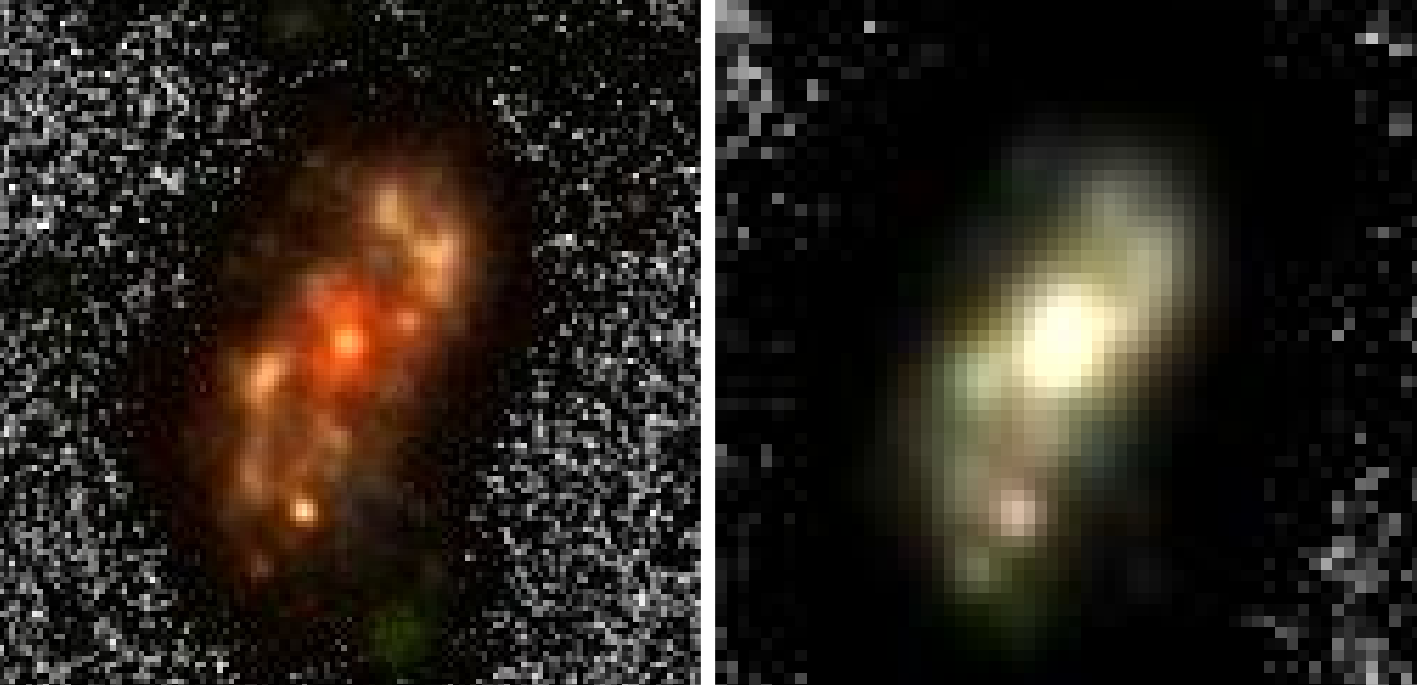
A team of researchers has identified a large, orderly spiral galaxy named Alaknanda, located approximately 12 billion light-years from Earth. This discovery, made using NASA’s James Webb Space Telescope, reveals a galaxy that formed during a time when the universe was merely 1.5 billion years old, shortly after the Big Bang. The findings challenge long-standing assumptions about the formation of galaxies in the early universe.
Historically, astronomers believed that galaxies formed chaotically in their infancy, resulting in irregular shapes rather than the distinct spiral structures seen in mature galaxies. Observations from the Hubble Space Telescope indicated that spiral galaxies were scarce at distances greater than 11 billion years. The discovery of Alaknanda raises significant questions about how such well-organized structures could emerge so early in cosmic history.
According to Yogesh Wadadekar, co-author of the study, “Alaknanda reveals that the early universe was capable of far more rapid galaxy assembly than we anticipated.” He noted that the galaxy managed to gather 10 billion solar masses of stars into a defined spiral disk in merely a few hundred million years, a process that is extraordinarily rapid by cosmic standards. This finding compels astronomers to reconsider their understanding of galaxy formation.
New Insights from Gravitational Lensing
The research team, based at the National Centre for Radio Astrophysics of the Tata Institute of Fundamental Research in India, utilized a phenomenon known as gravitational lensing to observe Alaknanda in remarkable detail. This effect occurs when the gravity of a massive galaxy cluster magnifies the light from a more distant object, making it appear brighter and easier to study.
The observations revealed that Alaknanda spans roughly 32,000 light-years across and exhibits a flat, rotating disk with two clear spiral arms. These arms are smooth and symmetrical, earning Alaknanda the designation of a “grand-design” spiral galaxy, characterized by well-defined structures rather than irregular clumps. The images showcase bright clusters of newborn stars along the spiral arms, indicating active star formation.
To determine the age of Alaknanda’s stars, scientists analyzed its brightness across 21 different wavelengths of light, from ultraviolet to infrared. The results suggest that the stars average about 200 million years old, with roughly half formed in a rapid burst after the universe was already over 1 billion years old.
Rapid Star Formation and Future Research
Alaknanda continues to grow at an impressive rate, forming new stars at a pace equivalent to about 63 solar masses per year. This rate is significantly faster than the Milky Way’s current star formation. The strong signals from glowing gas surrounding the new stars confirm the galaxy’s intense activity in star formation.
Scientists are still investigating how Alaknanda’s spiral arms formed so quickly in such an ancient galaxy. Some theories propose that they develop from slow-moving density patterns within the disk, while others suggest that gravitational disturbances from nearby galaxies or large gas clumps may play a role. Observations indicate that Alaknanda may have a small neighboring galaxy that could have influenced its spiral structure, although more evidence is needed to confirm this hypothesis.
Future research using the James Webb Space Telescope, along with radio telescopes, aims to map the motions of stars and gas within Alaknanda. Such observations will help determine whether the galaxy’s disk has settled into its final configuration or if the spiral arms represent a transitional phase in its development. This ongoing exploration into the early universe promises to reshape our understanding of galaxy formation and evolution.

Scientists Examine Signals from 3I/ATLAS, Debunk Alien Theories

Is Alexander Isak the Next Luis Suarez? Liverpool’s Big Signing Struggles

James Acaster’s Saturday Kitchen Meltdown Sparks Viewer Outrage

Montenegrin Journalists Gain Insight into EU Institutions in Brussels

Women’s Aid Opens Vibrant Pop-Up Shop in Antrim

Volcanic Eruption Linked to Environmental Changes Before Black Death

AI-Powered Facial Treatment Reveals True Needs of Skin

Education Ministry Files Eight Criminal Charges Over Fake Diplomas

Surrey Police Launches Campaign to Combat Drink and Drug Driving

Neurologist Warns Excessive Use of Supplements Can Harm Brain

Fiona Phillips’ Husband Shares Heartfelt Update on Her Alzheimer’s Journey

Brian Cox Addresses Claims of Alien Probe in 3I/ATLAS Discovery

NASA Investigates Unusual Comet 3I/ATLAS; New Findings Emerge

Scientists Examine 3I/ATLAS: Alien Artifact or Cosmic Oddity?

Kerry Katona Discusses Future Baby Plans and Brian McFadden’s Wedding

NASA Investigates Speedy Object 3I/ATLAS, Sparking Speculation

Emmerdale Faces Tension as Dylan and April’s Lives Hang in the Balance

Cole Palmer’s Cryptic Message to Kobbie Mainoo Following Loan Talks
-
 Health3 months ago
Neurologist Warns Excessive Use of Supplements Can Harm Brain
-
 Health3 months ago
Fiona Phillips’ Husband Shares Heartfelt Update on Her Alzheimer’s Journey
-
 Science2 months ago
Brian Cox Addresses Claims of Alien Probe in 3I/ATLAS Discovery
-
 Science2 months ago
NASA Investigates Unusual Comet 3I/ATLAS; New Findings Emerge
-
 Science1 month ago
Scientists Examine 3I/ATLAS: Alien Artifact or Cosmic Oddity?
-
 Entertainment5 months ago
Kerry Katona Discusses Future Baby Plans and Brian McFadden’s Wedding
-
 Science1 month ago
NASA Investigates Speedy Object 3I/ATLAS, Sparking Speculation
-
 Entertainment4 months ago
Emmerdale Faces Tension as Dylan and April’s Lives Hang in the Balance
-
 World3 months ago
Cole Palmer’s Cryptic Message to Kobbie Mainoo Following Loan Talks
-
 Science1 month ago
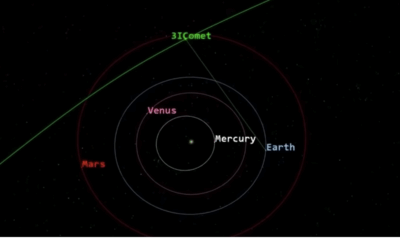
NASA Scientists Explore Origins of 3I/ATLAS, a Fast-Moving Visitor
-

 Entertainment2 months ago
Lewis Cope Addresses Accusations of Dance Training Advantage
-

 Entertainment4 months ago
Major Cast Changes at Coronation Street: Exits and Returns in 2025