
Science
Interstellar Object 3I/ATLAS Challenges Cometary Physics Near Jupiter

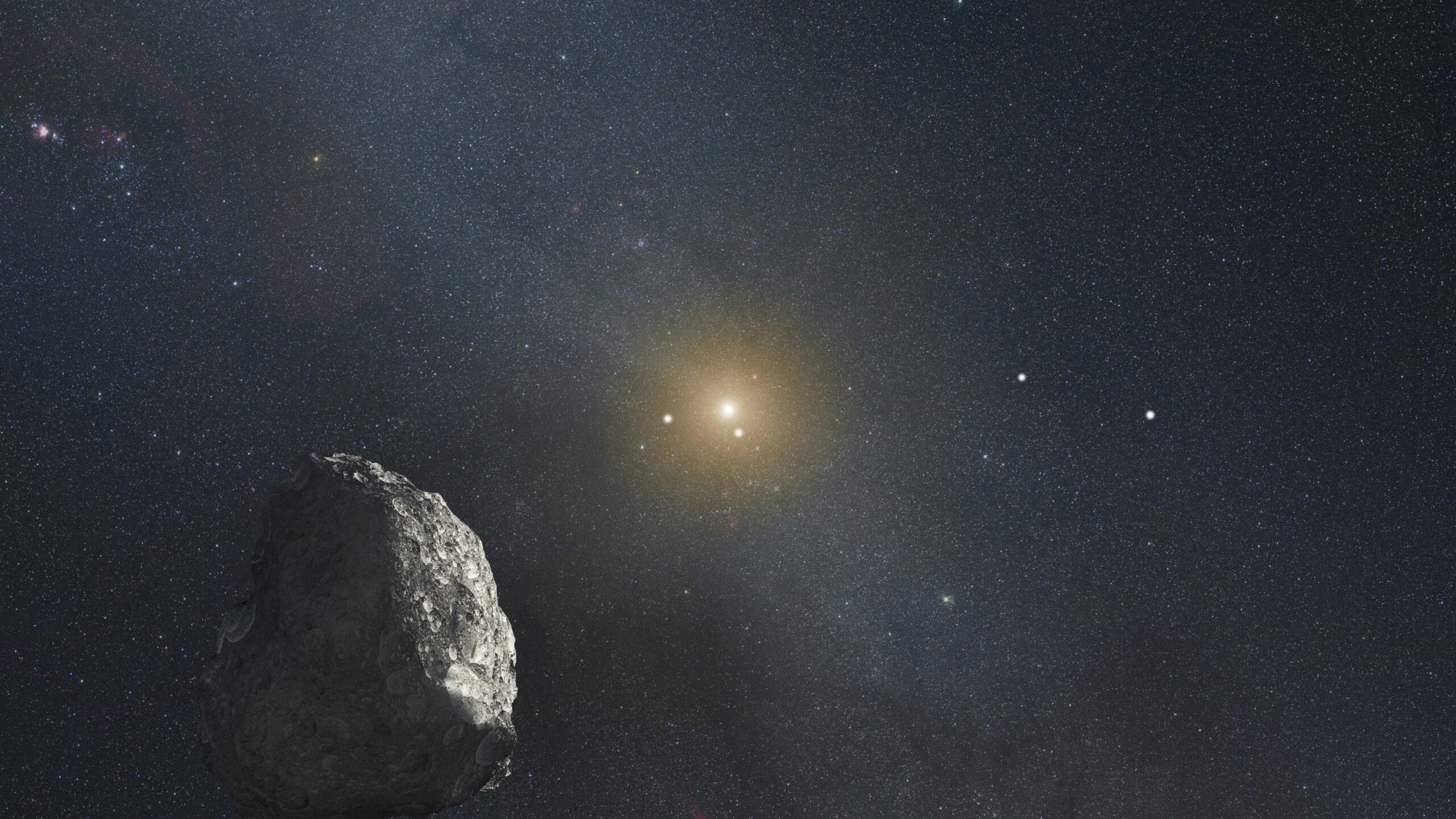
A remarkable interstellar object, designated as 3I/ATLAS, is approaching Jupiter and raising significant questions among scientists due to its unexpected behaviour. Officially classified as a comet by NASA, this object is travelling at extraordinary speeds and exhibiting characteristics that challenge conventional cometary physics, prompting intense scrutiny from the scientific community.
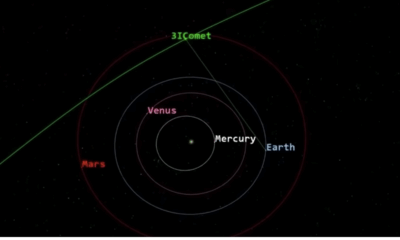
Discovered by the Asteroid Terrestrial-impact Last Alert System (ATLAS) in Chile on July 1, 2025, 3I/ATLAS is only the third confirmed interstellar object to be detected. Its hyperbolic trajectory signifies an origin beyond our solar system, sharing this distinction with previous visitors ‘Oumuamua and 2I/Borisov. As it nears the orbit of Jupiter, with a closest approach expected on March 16, 2026, researchers are gearing up for a unique opportunity to evaluate the nature of this interstellar object.
Unprecedented Observations and Data Collection
Multiple space observatories, including NASA’s heliophysics missions such as STEREO-A and SOHO, have successfully captured visible-light images of 3I/ATLAS, despite initial expectations that it would be too faint to detect. Observations from the James Webb Space Telescope (JWST) have provided further insights into the object’s coma and tail, revealing a rich chemical composition that includes carbon dioxide, water ice, and carbon monoxide.
The comet is currently travelling at speeds exceeding 130,000 miles per hour (209,000 kilometres per hour), consistent with its hyperbolic escape trajectory. According to Tom Statler, lead scientist for small bodies at NASA, 3I/ATLAS offers an “unparalleled chance to study material formed outside our own star system.” The object’s unique features, such as its high ratio of carbon dioxide to water vapour, raise intriguing questions about its formation and origin.
Unlike typical comets observed within our solar system, 3I/ATLAS displays unusual emissions of nickel and cyanide gas. Ground-based telescopes detected these chemical indicators, suggesting that the conditions in the comet’s progenitor system were atypical. Observational campaigns conducted between July and September 2025 revealed wobbling jets emanating from the comet’s coma, indicating complex outgassing activity that might be related to its rotation or structural asymmetries.
Scientific Debate and Theories
While a significant portion of the scientific community maintains that 3I/ATLAS is a natural comet, the object has sparked robust discussions about its behaviour. Some experts interpret certain features as unusual, leading to alternative theories regarding its origin. Avi Loeb, a prominent astrophysicist from Harvard University, has proposed that the alignment and brightness characteristics of 3I/ATLAS may be statistically improbable for a natural comet, suggesting that deeper investigation may be warranted.
Despite these alternative interpretations, the prevailing view in peer-reviewed research supports the notion that 3I/ATLAS aligns with known cometary physics, influenced by its proximity to the Sun. The dynamic behaviour observed, including periodic modulation in the direction and intensity of its jets, remains consistent with natural processes, specifically solar heating-driven outgassing.
As 3I/ATLAS continues its outbound journey, researchers are preparing for its closest approach to Jupiter. This alignment presents a critical opportunity to observe how an interstellar object interacts with the planet’s immense gravity and unique particle environment. Instruments on NASA’s Juno spacecraft and other Earth-orbiting observatories will play a pivotal role in this observational phase.
The legacy of 3I/ATLAS will not only be measured by its mystery but also by the valuable data it provides regarding planetary formation and the composition of distant star systems. As scientists strive to understand this interstellar visitor, 3I/ATLAS continues to push the boundaries of knowledge about the cosmos, inviting further exploration and inquiry into the nature of materials formed beyond our solar system.

Emmerdale Reveals Shocking Update on Tina Dingle After 30 Years

Perfume Enthusiast Reveals Must-Have Holiday Scent

Scientist Warns of New Chemical Weapons Development in Russia

Heating Plant Shutdown Scheduled Tomorrow in Pljevlja

PGE Secures Approval for Price Increase on 1GW Energy Storage Projects

Emmerdale Viewers Question Ray and Celia’s Inconsistent Storyline

Israeli Tech Firms Expand Operations Across Europe in 2023

Australian Sprint Star Gout Gout Celebrates £4.4M Home Purchase

Julia Bradbury Opens Up About Cancer Journey and Lifestyle Change

Andrew Pierce Confirms Departure from ITV’s Good Morning Britain

Neurologist Warns Excessive Use of Supplements Can Harm Brain

Fiona Phillips’ Husband Shares Heartfelt Update on Her Alzheimer’s Journey

Brian Cox Addresses Claims of Alien Probe in 3I/ATLAS Discovery

Gogglebox Star Helena Worthington Announces Break After Loss

NASA Investigates Unusual Comet 3I/ATLAS; New Findings Emerge

Tess Daly Honoured with MBE, Announces Departure from Strictly

Scientists Examine 3I/ATLAS: Alien Artifact or Cosmic Oddity?

Lewis Cope Addresses Accusations of Dance Training Advantage
-
 Entertainment3 weeks ago
Andrew Pierce Confirms Departure from ITV’s Good Morning Britain
-
 Health4 months ago
Neurologist Warns Excessive Use of Supplements Can Harm Brain
-
 Health4 months ago
Fiona Phillips’ Husband Shares Heartfelt Update on Her Alzheimer’s Journey
-
 Science2 months ago
Brian Cox Addresses Claims of Alien Probe in 3I/ATLAS Discovery
-
 Entertainment2 weeks ago
Gogglebox Star Helena Worthington Announces Break After Loss
-
 Science2 months ago
NASA Investigates Unusual Comet 3I/ATLAS; New Findings Emerge
-
 Entertainment2 months ago
Tess Daly Honoured with MBE, Announces Departure from Strictly
-
 Science2 months ago
Scientists Examine 3I/ATLAS: Alien Artifact or Cosmic Oddity?
-
 Entertainment3 months ago
Lewis Cope Addresses Accusations of Dance Training Advantage
-

 Entertainment6 months ago
Kerry Katona Discusses Future Baby Plans and Brian McFadden’s Wedding
-
 Science2 months ago
NASA Investigates Speedy Object 3I/ATLAS, Sparking Speculation
-

 Entertainment5 months ago
Emmerdale Faces Tension as Dylan and April’s Lives Hang in the Balance