
Science
NASA’s Fermi Telescope Offers Potential Evidence of Dark Matter


Scientists may have taken a significant step toward confirming the existence of dark matter, a substance theorized to make up about 27% of the universe. Using data from the NASA Fermi Gamma-ray Space Telescope, researchers suggest they have detected evidence of this elusive matter for the first time.
In the early 1930s, Swiss astronomer Fritz Zwicky made a groundbreaking observation of galaxies moving at speeds that seemed impossible based on their visible mass. His findings led to the hypothesis that an unseen force, which he termed dark matter, was providing the necessary gravitational pull to keep these galaxies bound together. Nearly a century later, NASA’s Fermi telescope is bringing new insights to this long-standing mystery.
The Fermi telescope employs gamma-ray observations to explore high-energy phenomena in the universe. Recent data analysis indicates a potential signature of dark matter interactions. By examining specific gamma-ray emissions, scientists believe they have found traces that may correspond to the annihilation of dark matter particles. This could represent a pivotal moment in astrophysics, as it would allow dark matter to be “seen” indirectly for the first time.
Exploring the Implications of Dark Matter
Dark matter is critical for understanding the universe’s structure and evolution. It does not emit, absorb, or reflect light, making it invisible and detectable only through its gravitational effects on visible matter. The presence of dark matter helps explain phenomena such as the rotation curves of galaxies and the formation of large-scale cosmic structures.
The implications of this discovery are profound. If confirmed, it would not only validate decades of theoretical work but also open new avenues for research into the fundamental makeup of the universe. The Fermi telescope’s findings could inspire further investigations into dark matter’s properties and its role in cosmic evolution.
The scientific community has responded with cautious optimism to these findings. While the data is promising, further analysis is necessary to validate the results. Researchers are already planning additional observational campaigns and theoretical studies to enhance understanding of dark matter’s characteristics.
The Future of Dark Matter Research
As technology advances, tools like the Fermi Gamma-ray Space Telescope will play a crucial role in unraveling the mysteries of dark matter. Future missions and experiments, including ground-based observatories and upcoming space telescopes, are set to contribute to this ongoing quest.
Collaboration among international scientists will be essential to establish a consensus regarding these findings. As researchers delve deeper into this cosmic puzzle, the hope is that they will eventually piece together the elusive nature of dark matter and its significance in the universe.
In summary, the potential detection of dark matter by NASA’s Fermi Gamma-ray Space Telescope marks an exciting milestone in astrophysics. With rigorous analysis and further investigation, scientists may soon unlock the secrets of this fundamental component of our universe.

Researchers Unveil Noise-Proof Quantum Sensor with Calcium Ions

Tom Aspinall Accuses Ciryl Gane of Intentional Eye Poke at UFC 321

Iconic Paintings Reimagined with AI: A Modern Beauty Revival

Dornoch Community Hub Funding Secured with £280,000 Grant

New Children’s Book Celebrates Charles Thomson’s Legacy

Fans Unravel Sinister Vecna Secrets in Stranger Things Season 5

Comet 3I/ATLAS Reveals Rare Metal Composition, Suggests Cryovolcanism

Mike Vrabel Transforms Patriots into AFC Contenders in 2024

Search Intensifies for Missing British Teen Near Dracula’s Castle

Neurologist Warns Excessive Use of Supplements Can Harm Brain

Fiona Phillips’ Husband Shares Heartfelt Update on Her Alzheimer’s Journey

Brian Cox Addresses Claims of Alien Probe in 3I/ATLAS Discovery

NASA Investigates Unusual Comet 3I/ATLAS; New Findings Emerge

Scientists Examine 3I/ATLAS: Alien Artifact or Cosmic Oddity?

NASA Investigates Speedy Object 3I/ATLAS, Sparking Speculation

Kerry Katona Discusses Future Baby Plans and Brian McFadden’s Wedding

Emmerdale Faces Tension as Dylan and April’s Lives Hang in the Balance

Cole Palmer’s Cryptic Message to Kobbie Mainoo Following Loan Talks
-
 Health3 months ago
Neurologist Warns Excessive Use of Supplements Can Harm Brain
-
 Health3 months ago
Fiona Phillips’ Husband Shares Heartfelt Update on Her Alzheimer’s Journey
-
 Science1 month ago
Brian Cox Addresses Claims of Alien Probe in 3I/ATLAS Discovery
-
 Science1 month ago
NASA Investigates Unusual Comet 3I/ATLAS; New Findings Emerge
-
 Science1 month ago
Scientists Examine 3I/ATLAS: Alien Artifact or Cosmic Oddity?
-
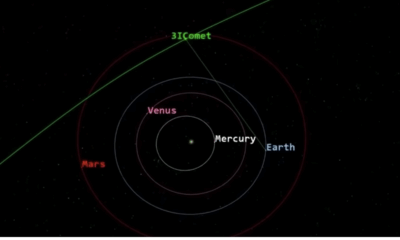 Science1 month ago
NASA Investigates Speedy Object 3I/ATLAS, Sparking Speculation
-
 Entertainment5 months ago
Kerry Katona Discusses Future Baby Plans and Brian McFadden’s Wedding
-
 Entertainment4 months ago
Emmerdale Faces Tension as Dylan and April’s Lives Hang in the Balance
-
 World3 months ago
Cole Palmer’s Cryptic Message to Kobbie Mainoo Following Loan Talks
-
 Science1 month ago
NASA Scientists Explore Origins of 3I/ATLAS, a Fast-Moving Visitor
-

 Entertainment2 months ago
Lewis Cope Addresses Accusations of Dance Training Advantage
-

 Entertainment3 months ago
Major Cast Changes at Coronation Street: Exits and Returns in 2025