
Science
Comet 3I/ATLAS Stirs Interest with Unusual Sunward Features

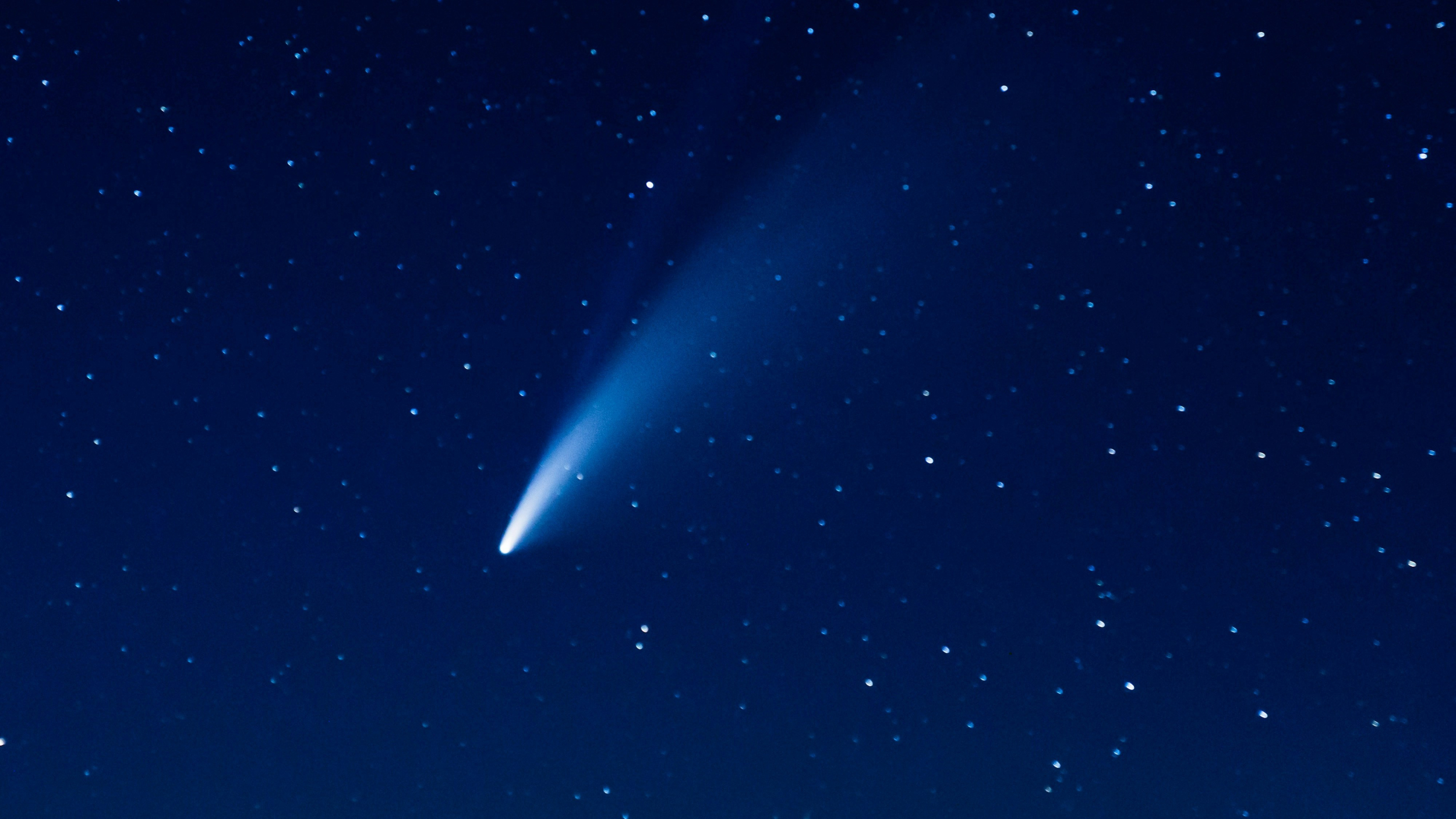
Comet 3I/ATLAS is captivating astronomers with its unexpected behavior as it navigates out of the inner solar system. This comet exhibits peculiar features that deviate from the typical patterns seen in other comets. Notably, it has developed a striking sunward-pointing dust feature and shifting jet-like structures that change position in a repetitive manner.
The most intriguing aspect of 3I/ATLAS is its pronounced “anti-tail,” which stretches approximately 1,000,000 km towards the Sun, contrary to the conventional tail that usually trails behind a comet. Anti-tails, while rare, can occur under specific viewing conditions; however, the strength and structure of this one have positioned the comet as a focal point for scientists investigating interstellar bodies.
Astronomers typically observe comets developing a coma and tail as sunlight heats their surface ice, releasing gas and dust. This process results in radiation pressure and solar wind pushing fine materials outward, creating a tail that points away from the Sun. In the case of 3I/ATLAS, the reported anti-tail has garnered attention due to its distinct characteristics, including a structured appearance rather than a simple, smooth streak.
In addition to the anti-tail, astronomers noted intermittent jet-like features that are not stationary. Instead, these jets shift direction in a pattern consistent with a repeating motion, indicating that the nucleus of the comet may be rotating while an active region periodically emits material.
A dedicated observing campaign using the Two-metre Twin Telescope (TTT) at Teide Observatory in Tenerife tracked 3I/ATLAS over a span of 37 nights. Researchers identified a precessional pattern with a period of 7 hours 45 minutes, suggesting that the nucleus rotates approximately every 15 hours 30 minutes.
3I/ATLAS is recognized as only the third confirmed interstellar object to enter our solar system, following 1I/’Oumuamua in 2017 and 2I/Borisov in 2019. Each of these interstellar visitors has expanded the scientific community’s understanding of small bodies formed outside our solar system. While Borisov appeared more typical of comets, ‘Oumuamua sparked significant debate due to its unusual shape and non-gravitational acceleration.
If 3I/ATLAS indeed demonstrates a well-defined anti-tail and observable jet precession, it could provide one of the most detailed case studies of an interstellar object to date.
After its closest approach to the Sun, 3I/ATLAS made its nearest pass to Earth on December 19, 2023, at a distance of approximately 270,000,000 km. It is now following a hyperbolic trajectory that will lead it out of the solar system permanently. This fleeting opportunity for observation underscores the importance of capturing detailed measurements. Each interstellar object presents a rare chance to explore “foreign” small-body physics, including dust behavior, volatile release, nucleus rotation, and jet morphology, compared to the comets and asteroids that have been studied more extensively.
Regardless of whether the anti-tail is primarily a geometric illusion, the variability of the observed jets and the inferred rotation offer valuable insights into the surface activity of an object that likely originated around another star. As astronomers continue to analyze the data from 3I/ATLAS, it will undoubtedly contribute significantly to our understanding of interstellar materials and their characteristics.

Goshen Police Officers Honored for Exceptional Service

Judge to Decide Gas Tax Referendum Timing in Oregon Case

Genius Sports Enhances In-Play Football Betting for 2026

Budućnost Voli Faces Kluž in Crucial EuroCup Clash

Good Morning Britain Suspends Broadcast Following Trump’s Warning

Putin Gains Advantage as Oil Prices Surge Amid Middle East Tensions

MoistCr1tikal Critiques His Netflix Cameo in Baki Series

Ben Nicky Returns to Belfast with Groundbreaking Laser Show

Lincolnshire Co-op Boosts Food Banks with $50,000 Funding Initiative

Andrew Pierce Confirms Departure from ITV’s Good Morning Britain

Fiona Phillips’ Husband Shares Heartfelt Update on Her Alzheimer’s Journey

Neurologist Warns Excessive Use of Supplements Can Harm Brain

Gogglebox Star Helena Worthington Announces Break After Loss

Brian Cox Addresses Claims of Alien Probe in 3I/ATLAS Discovery

NASA Investigates Unusual Comet 3I/ATLAS; New Findings Emerge

EastEnders Welcomes Back Mark Fowler Jr. with New Actor

Tess Daly Honoured with MBE, Announces Departure from Strictly

Coronation Street Reveals Audrey Roberts’ Absence Explained
-
 Entertainment3 months ago
Andrew Pierce Confirms Departure from ITV’s Good Morning Britain
-
 Health7 months ago
Fiona Phillips’ Husband Shares Heartfelt Update on Her Alzheimer’s Journey
-
 Health6 months ago
Neurologist Warns Excessive Use of Supplements Can Harm Brain
-
 Entertainment3 months ago
Gogglebox Star Helena Worthington Announces Break After Loss
-
 Science5 months ago
Brian Cox Addresses Claims of Alien Probe in 3I/ATLAS Discovery
-
 Science5 months ago
NASA Investigates Unusual Comet 3I/ATLAS; New Findings Emerge
-
 World2 months ago
EastEnders Welcomes Back Mark Fowler Jr. with New Actor
-
 Entertainment4 months ago
Tess Daly Honoured with MBE, Announces Departure from Strictly
-
 Entertainment2 weeks ago
Coronation Street Reveals Audrey Roberts’ Absence Explained
-

 World4 months ago
Bailey and Rebecca Announce Heartbreaking Split After MAFS Reunion
-

 Entertainment8 months ago
Kerry Katona Discusses Future Baby Plans and Brian McFadden’s Wedding
-

 Health2 months ago
Sue Radford Reveals Weight Loss Journey, Losing Two Stone