
World
Visionary Architect Frank Gehry Passes Away at 96

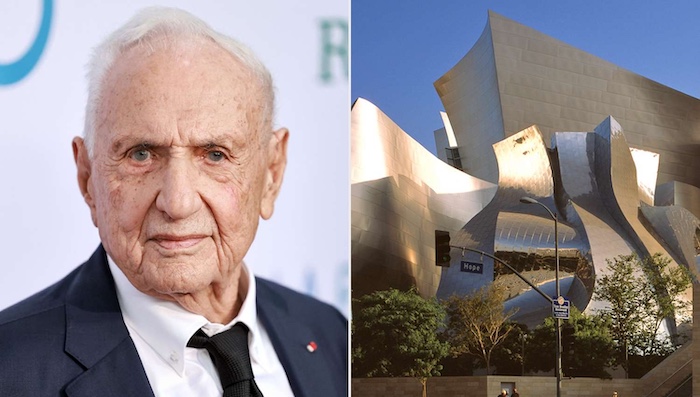
Frank Gehry, the renowned architect celebrated for his innovative and sculptural buildings, has died at the age of 96. His passing was confirmed by his chief of staff, Meaghan Lloyd, on March 15, 2024. Gehry leaves behind a legacy of transformative architecture that reshaped urban landscapes and inspired a new generation of designers.
Gehry gained international acclaim following the opening of the titanium-clad Guggenheim Museum in Bilbao, Spain, in 1997. This iconic structure is widely credited with reviving the city’s economy, giving rise to what has been termed the “Bilbao effect.” This phenomenon illustrates how striking architectural projects can rejuvenate urban environments and attract global attention.
Born in Toronto in 1929, Gehry relocated to Los Angeles as a teenager. He pursued his architectural education at the University of Southern California and later completed postgraduate studies at Harvard’s Graduate School of Design. He established his own practice, quickly distinguishing himself from traditional architectural norms by embracing asymmetry, unconventional materials, and raw surfaces. This approach became known as deconstructivism.
Gehry’s breakthrough came with his Santa Monica home, where he creatively utilized chain-link fencing, plywood, and corrugated metal. His pioneering use of advanced 3D modeling, influenced by aerospace engineering, allowed him to design sweeping, curvaceous structures that were previously deemed impossible.
In recognition of his contributions to architecture, Gehry was awarded the prestigious Pritzker Prize in 1989. The jury lauded his “highly refined, sophisticated and adventurous aesthetic,” drawing parallels between his work and the improvisational nature of jazz. His designs, including the Walt Disney Concert Hall in Los Angeles, Jay Pritzker Pavilion in Chicago, and the Louis Vuitton Foundation in Paris, became landmarks of modern architecture.
The Guggenheim Museum in Bilbao, with its stunning combination of titanium, glass, and limestone, remains one of Gehry’s most celebrated achievements. Architect Philip Johnson famously described it as “the greatest building of our time.” Gehry’s distinctive style, characterized by fluidity and unpredictability, captured public imagination, leading to both admiration and parody. His cameo on The Simpsons, where a crumpled piece of paper inspires a building design, became a cultural reference that he later remarked “haunted” him.
Tributes have poured in from around the globe in response to his passing. Bernard Arnault, CEO of LVMH, referred to Gehry’s Paris building as “his greatest masterpiece.” Architectural critic Paul Goldberger noted that Gehry was “one of the few architects to engage people emotionally,” emphasizing that he continued to work with full creative energy until the end of his life.
Canadian Prime Minister Mark Carney expressed condolences to Gehry’s family, stating that his vision “lives on in iconic buildings around the world.” The Guggenheim Museum in Bilbao also paid tribute, affirming that Gehry’s legacy “will always remain connected to Bilbao.”
Gehry is survived by his wife, Berta Isabel Aguilera, along with two daughters from his first marriage, Leslie and Brina, and two sons, Alejandro and Samuel. His innovative spirit and architectural contributions will undoubtedly resonate for generations to come.

Goshen Police Officers Honored for Exceptional Service

Judge to Decide Gas Tax Referendum Timing in Oregon Case

Genius Sports Enhances In-Play Football Betting for 2026

Budućnost Voli Faces Kluž in Crucial EuroCup Clash

Good Morning Britain Suspends Broadcast Following Trump’s Warning

Putin Gains Advantage as Oil Prices Surge Amid Middle East Tensions

MoistCr1tikal Critiques His Netflix Cameo in Baki Series

Ben Nicky Returns to Belfast with Groundbreaking Laser Show

Lincolnshire Co-op Boosts Food Banks with $50,000 Funding Initiative

Andrew Pierce Confirms Departure from ITV’s Good Morning Britain

Fiona Phillips’ Husband Shares Heartfelt Update on Her Alzheimer’s Journey

Neurologist Warns Excessive Use of Supplements Can Harm Brain

Gogglebox Star Helena Worthington Announces Break After Loss

Brian Cox Addresses Claims of Alien Probe in 3I/ATLAS Discovery

NASA Investigates Unusual Comet 3I/ATLAS; New Findings Emerge

EastEnders Welcomes Back Mark Fowler Jr. with New Actor

Tess Daly Honoured with MBE, Announces Departure from Strictly

Coronation Street Reveals Audrey Roberts’ Absence Explained
-
 Entertainment3 months ago
Andrew Pierce Confirms Departure from ITV’s Good Morning Britain
-
 Health7 months ago
Fiona Phillips’ Husband Shares Heartfelt Update on Her Alzheimer’s Journey
-
 Health6 months ago
Neurologist Warns Excessive Use of Supplements Can Harm Brain
-
 Entertainment3 months ago
Gogglebox Star Helena Worthington Announces Break After Loss
-
 Science5 months ago
Brian Cox Addresses Claims of Alien Probe in 3I/ATLAS Discovery
-
 Science5 months ago
NASA Investigates Unusual Comet 3I/ATLAS; New Findings Emerge
-
 World2 months ago
EastEnders Welcomes Back Mark Fowler Jr. with New Actor
-
 Entertainment4 months ago
Tess Daly Honoured with MBE, Announces Departure from Strictly
-
 Entertainment2 weeks ago
Coronation Street Reveals Audrey Roberts’ Absence Explained
-

 World4 months ago
Bailey and Rebecca Announce Heartbreaking Split After MAFS Reunion
-

 Entertainment8 months ago
Kerry Katona Discusses Future Baby Plans and Brian McFadden’s Wedding
-

 Health2 months ago
Sue Radford Reveals Weight Loss Journey, Losing Two Stone