
Business
Singapore Airlines and Cathay Pacific: Fleet Comparisons Unveiled

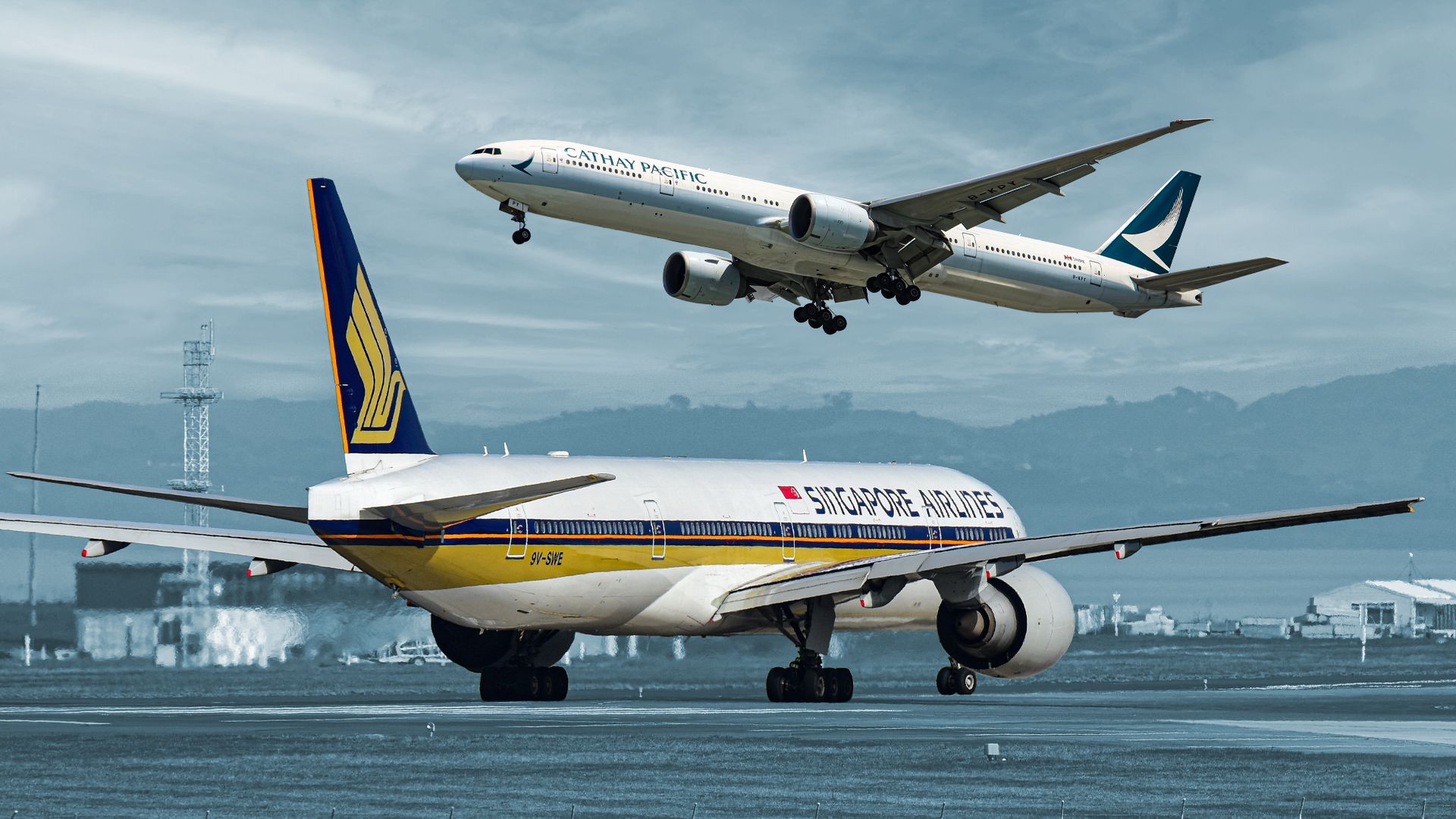
Singapore Airlines and Cathay Pacific are two of Asia’s leading full-service airlines, renowned for their long-haul routes and premium services. In terms of fleet size, Cathay Pacific currently holds a larger widebody aircraft fleet compared to Singapore Airlines, despite the latter transporting more passengers in the fiscal year 2024.
Both airlines play a crucial role in connecting Asia with Europe, North America, and Australia. Singapore Airlines carried approximately 26.5 million passengers in fiscal year 2024, while Cathay Pacific transported 22.8 million passengers in the same period. Their operational strategies have evolved but remain heavily influenced by their geographical locations—Singapore serves as a significant Southeast Asian gateway, whereas Hong Kong is a pivotal financial and transit hub.
Overview of Each Airline
Singapore Airlines is recognized as the flag carrier of Singapore and emphasizes a strong service ethos focused on long-haul travel. Operating from Singapore Changi Airport (SIN), the airline connects major cities across Asia, Europe, Australia, and North America. Cathay Pacific, based in Hong Kong, shares a similar operational structure, with its hub at Hong Kong International Airport (HKG) facilitating extensive regional and long-haul connectivity.
Both airlines rely significantly on connecting traffic, where many passengers utilize their hubs for transit rather than starting or ending their journeys at Singapore or Hong Kong. Singapore Airlines is a member of the Star Alliance, while Cathay Pacific belongs to the oneworld alliance, enhancing their passenger networks through partnerships.
A Closer Look at Their Widebody Fleets
Widebody aircraft are central to the operations of both airlines, with their long-haul networks comprising major models from Airbus and Boeing. Cathay Pacific’s fleet features a combination of A330s, A350s, and 777s. In contrast, Singapore Airlines relies heavily on the A350 family, supplemented by a small but significant fleet of A380s, along with 777s and 787s.
The following chart illustrates their current widebody aircraft in service:
Widebody Fleets (Passenger Aircraft)
| Airline | Aircraft | Quantity in Service |
|———————-|——————–|———————|
| Singapore Airlines | A350-900 | 56 |
| | A350-900ULR | 7 |
| | A380-800 | 9 |
| | 777-300 | 16 |
| | 787-10 | 23 |
| | **Total** | **116** |
| Cathay Pacific | A330-300 | 41 |
| | A350-900 | 17 |
| | A350-1000 | 29 |
| | 777-300ER | 33 |
| | **Total** | **136** |
Source: ch-aviation
Cathay Pacific’s larger widebody fleet is attributed to its operational choice of aircraft models, including the A330, A350-1000, and 777-300ER. Singapore Airlines leans towards a more specialized fleet, with the A350-900 as the backbone of its long-haul services. Looking to the future, Cathay Pacific has placed an order for 30 A330-900neos, while Singapore Airlines has 31 Boeing 777X aircraft on order.
Both airlines maintain a singular narrowbody aircraft type: Cathay Pacific operates the Airbus A321neo, while Singapore Airlines flies the Boeing 737 MAX 8. Cathay Pacific has 16 A321neos in service, with an additional 15 on order. Meanwhile, Singapore Airlines operates 19 737 MAX 8s with seven more to be delivered.
Most of Cathay Pacific’s A321neo operations focus on mainland China, along with nearby Asian destinations. Singapore Airlines utilizes the 737 MAX fleet extensively across Asia, including the notable route to Busan, the longest flight for this aircraft type.
Cargo Operations and Market Reach
Both airlines have significant cargo operations, using a mix of dedicated freighter aircraft and the cargo space available in their passenger fleets. This approach maximizes cargo capacity on long-haul flights while serving the high-demand freight markets effectively. Cathay Pacific leads in cargo operations, benefitting from its base at Hong Kong International Airport, one of the world’s busiest cargo hubs.
The cargo fleets are as follows:
Cargo Fleets
| Airline | Aircraft | Quantity in Service |
|———————-|——————–|———————|
| Singapore Airlines | 777-200F | 5 |
| | **Total** | **5** |
| Cathay Pacific | 747-400ERF | 6 |
| | 747-8F | 14 |
| | **Total** | **20** |
Both airlines have committed to next-generation cargo aircraft, with Singapore Airlines ordering seven Airbus A350F freighters and Cathay Pacific securing six. These freighters are expected to provide significant efficiency upgrades, as they are designed to handle oversized freight with a large main deck cargo door.
Conclusion and Future Outlook
As both airlines continue to invest in next-generation aircraft, their fleet choices reflect their geographical positioning and network strategies. Singapore Airlines and Cathay Pacific have made commitments to modernize their operations with the introduction of the Boeing 777X and A330-900neo.
Additionally, both airlines operate low-cost subsidiaries—Singapore Airlines with Scoot and Cathay Pacific with HK Express—to cater to different market segments. These strategic choices position both carriers to remain competitive within the evolving landscape of air travel in Asia and beyond.
Overall, while Cathay Pacific boasts a larger widebody fleet, Singapore Airlines maintains a diverse mix of long-haul aircraft, ensuring their continued influence in the region’s aviation market.

Deep Sea Mining Threatens Biodiversity, Report Reveals Alarming Losses

England Faces Tough Challenge in World Cup Group Draw

Heavy Rain Threatens Flooding Along River Severn in Gloucestershire

Buducnost Voli Falls Short Against Burg in Eurocup Match

Co Armagh Man Charged with Indecent Exposure Banned from Park

Experts Propose Comprehensive Wastewater Treatment Solution for Podgorica

Tom Homan Confronts Critics at UTEP Immigration Event

Programmable CRISPR Platform Accelerates Stem Cell Research Timelines

Experts Call for Advanced Wastewater Treatment in Podgorica

Neurologist Warns Excessive Use of Supplements Can Harm Brain

Fiona Phillips’ Husband Shares Heartfelt Update on Her Alzheimer’s Journey

Brian Cox Addresses Claims of Alien Probe in 3I/ATLAS Discovery

NASA Investigates Unusual Comet 3I/ATLAS; New Findings Emerge

Scientists Examine 3I/ATLAS: Alien Artifact or Cosmic Oddity?

Kerry Katona Discusses Future Baby Plans and Brian McFadden’s Wedding

NASA Investigates Speedy Object 3I/ATLAS, Sparking Speculation

Emmerdale Faces Tension as Dylan and April’s Lives Hang in the Balance

Cole Palmer’s Cryptic Message to Kobbie Mainoo Following Loan Talks
-
 Health3 months ago
Neurologist Warns Excessive Use of Supplements Can Harm Brain
-
 Health3 months ago
Fiona Phillips’ Husband Shares Heartfelt Update on Her Alzheimer’s Journey
-
 Science2 months ago
Brian Cox Addresses Claims of Alien Probe in 3I/ATLAS Discovery
-
 Science2 months ago
NASA Investigates Unusual Comet 3I/ATLAS; New Findings Emerge
-
 Science1 month ago
Scientists Examine 3I/ATLAS: Alien Artifact or Cosmic Oddity?
-
 Entertainment5 months ago
Kerry Katona Discusses Future Baby Plans and Brian McFadden’s Wedding
-
 Science1 month ago
NASA Investigates Speedy Object 3I/ATLAS, Sparking Speculation
-
 Entertainment4 months ago
Emmerdale Faces Tension as Dylan and April’s Lives Hang in the Balance
-
 World3 months ago
Cole Palmer’s Cryptic Message to Kobbie Mainoo Following Loan Talks
-

 Science1 month ago
NASA Scientists Explore Origins of 3I/ATLAS, a Fast-Moving Visitor
-

 Entertainment2 months ago
Lewis Cope Addresses Accusations of Dance Training Advantage
-

 Entertainment3 months ago
Major Cast Changes at Coronation Street: Exits and Returns in 2025