
Science
ESA’s Juice Captures Stunning Close-Up of Interstellar Comet 3I/ATLAS

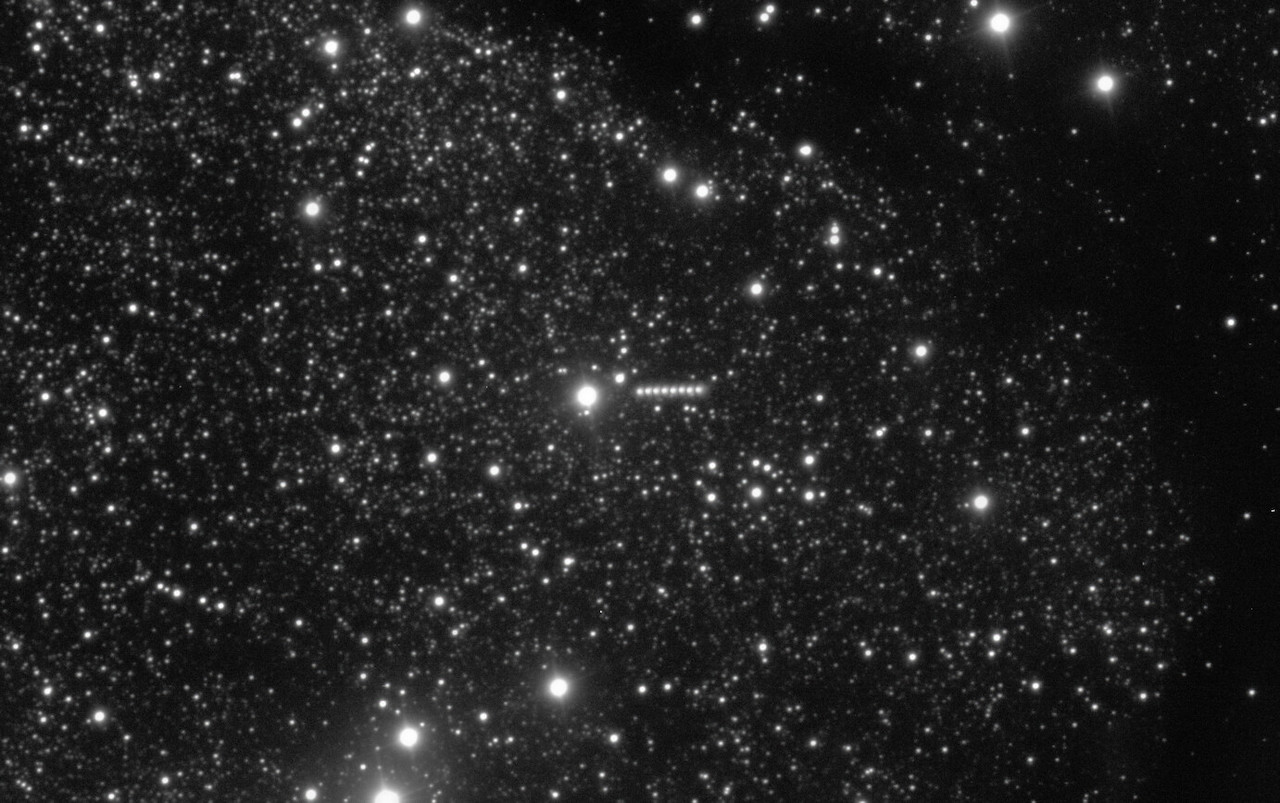
An extraordinary astronomical event unfolded as the European Space Agency’s (ESA) Jupiter Icy Moons Explorer, known as Juice, encountered the interstellar comet 3I/ATLAS. This unexpected meeting occurred during Juice’s eight-year mission to explore Jupiter’s moons, providing scientists with a rare opportunity to observe a highly active visitor from beyond our solar system. The initial findings, based on a fraction of data downloaded from Juice’s Navigation Camera (NavCam), have left researchers eager for more comprehensive data expected in early 2026.
The comet, first detected by the ATLAS telescope network on July 1, 2025, made its closest approach to Juice on November 4, 2025, at a distance of approximately 66 million kilometers. This was shortly after the comet reached its perihelion—the point in its orbit closest to the Sun—on October 29, 2025. At this time, 3I/ATLAS was shedding material, showcasing its volatile nature.
Juice’s scientific instruments, including JANUS, MAJIS, UVS, SWI, and PEP, were employed to gather critical data on the comet’s composition and behavior. The spacecraft’s unique position allowed for observations during the comet’s peak activity, providing insights into its physical characteristics. Despite the limitations of a low-resolution camera, the NavCam image captured striking details, including the comet’s coma and two distinct tails—a plasma tail extending upwards and a fainter dust tail.
The striking features visible in the teaser image confirmed that scientists had indeed observed 3I/ATLAS during a period of intense outgassing. The high speed of the comet, with an orbital eccentricity estimated at around 6.139, confirmed its interstellar origins, as it is traveling on a hyperbolic trajectory that is not gravitationally bound to the Sun.
Data transmission from Juice is currently delayed as the spacecraft employs a protective maneuver to shield its high-gain antenna from solar radiation. As a result, data is being sent back to Earth at a slower rate through a secondary medium-gain antenna. The comprehensive data from the five scientific instruments is anticipated to arrive on February 18 and 20, 2026, and scientists are eager to analyze this information.
The upcoming data is expected to include high-resolution images from the JANUS optical camera, spectrometry data from MAJIS and UVS, as well as composition data from SWI, which is particularly sensitive to water molecules and other volatiles. The PEP instrument will provide particle data related to interactions with solar wind.
This unique encounter with 3I/ATLAS marks only the third confirmed interstellar object discovered, and the insights gained may shed light on the chemical makeup of celestial bodies from other star systems. The preliminary observations indicate that the comet is actively shedding materials, providing a glimpse into its ancient chemistry and possibly the processes involved in planetary formation across the galaxy.
As the data awaits transmission, the scientific community remains excited about the potential discoveries that lie ahead. The Juice mission continues its journey towards Jupiter, set to arrive in 2031, while this unexpected encounter with 3I/ATLAS adds an exciting chapter to the ongoing exploration of our universe.

Co Armagh Man Charged with Indecent Exposure Banned from Park

Experts Propose Comprehensive Wastewater Treatment Solution for Podgorica

Tom Homan Confronts Critics at UTEP Immigration Event

Programmable CRISPR Platform Accelerates Stem Cell Research Timelines

Experts Call for Advanced Wastewater Treatment in Podgorica

Kevin Sinfield Exceeds Fundraising Goal Ahead of Final Marathons

Urgent Health Warning: Rotavirus Cases Surge by 50% Globally

AI’s Impact on Education Sparks Debate Over Future Skills

Local Governments Face Deadline to Address Stray Livestock Crisis

Neurologist Warns Excessive Use of Supplements Can Harm Brain

Fiona Phillips’ Husband Shares Heartfelt Update on Her Alzheimer’s Journey

Brian Cox Addresses Claims of Alien Probe in 3I/ATLAS Discovery

NASA Investigates Unusual Comet 3I/ATLAS; New Findings Emerge

Scientists Examine 3I/ATLAS: Alien Artifact or Cosmic Oddity?

Kerry Katona Discusses Future Baby Plans and Brian McFadden’s Wedding

NASA Investigates Speedy Object 3I/ATLAS, Sparking Speculation

Emmerdale Faces Tension as Dylan and April’s Lives Hang in the Balance

Cole Palmer’s Cryptic Message to Kobbie Mainoo Following Loan Talks
-
 Health3 months ago
Neurologist Warns Excessive Use of Supplements Can Harm Brain
-
 Health3 months ago
Fiona Phillips’ Husband Shares Heartfelt Update on Her Alzheimer’s Journey
-
 Science2 months ago
Brian Cox Addresses Claims of Alien Probe in 3I/ATLAS Discovery
-
 Science2 months ago
NASA Investigates Unusual Comet 3I/ATLAS; New Findings Emerge
-
 Science1 month ago
Scientists Examine 3I/ATLAS: Alien Artifact or Cosmic Oddity?
-
 Entertainment5 months ago
Kerry Katona Discusses Future Baby Plans and Brian McFadden’s Wedding
-
 Science1 month ago
NASA Investigates Speedy Object 3I/ATLAS, Sparking Speculation
-
 Entertainment4 months ago
Emmerdale Faces Tension as Dylan and April’s Lives Hang in the Balance
-
 World3 months ago
Cole Palmer’s Cryptic Message to Kobbie Mainoo Following Loan Talks
-
 Science1 month ago
NASA Scientists Explore Origins of 3I/ATLAS, a Fast-Moving Visitor
-

 Entertainment2 months ago
Lewis Cope Addresses Accusations of Dance Training Advantage
-

 Entertainment3 months ago
Major Cast Changes at Coronation Street: Exits and Returns in 2025