
Science
Harvard Scientist Proposes Cosmic Origins for Life on Earth

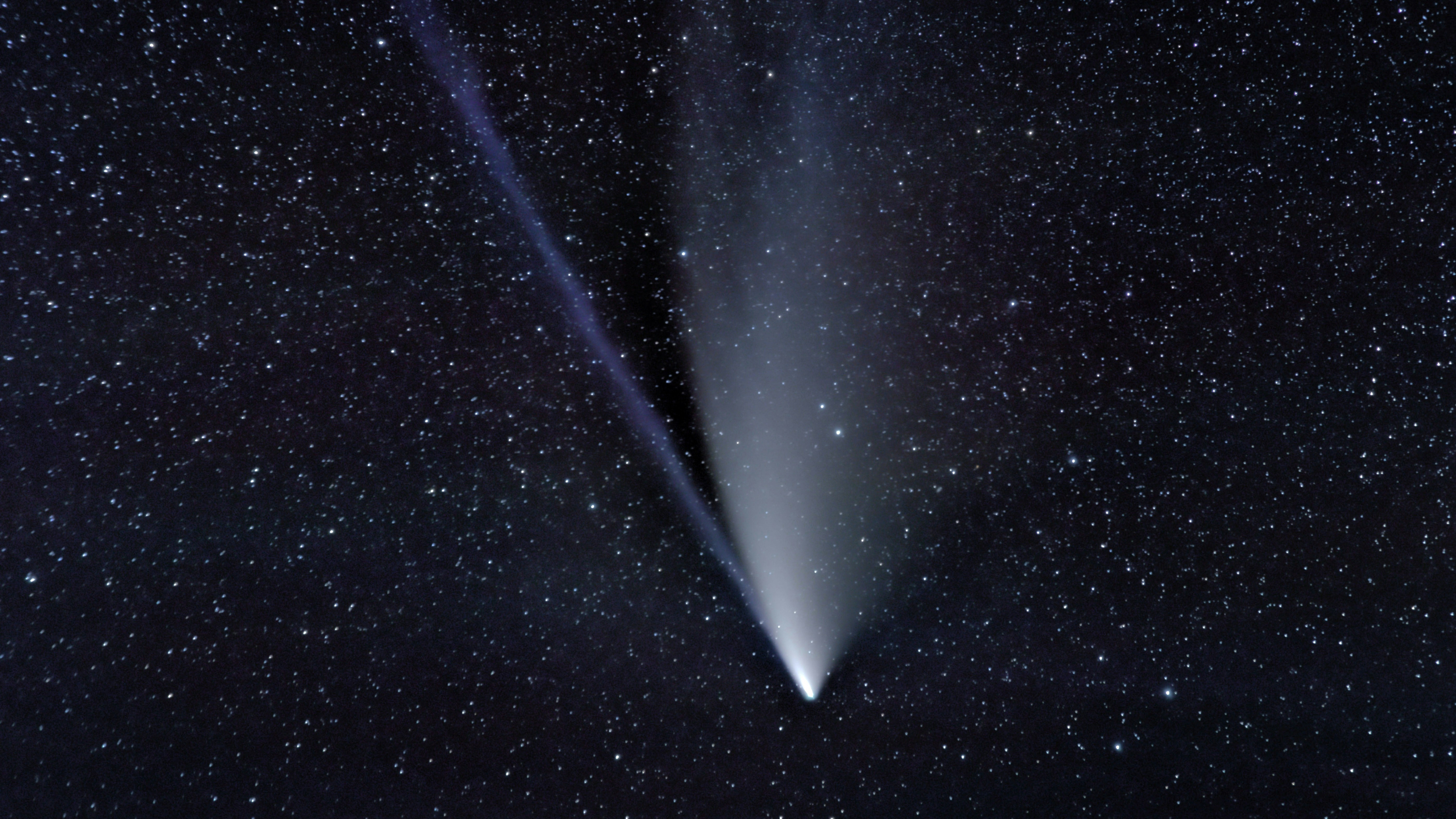
The recent arrival of the interstellar object 3I/ATLAS has sparked renewed debate over the origins of life on Earth. While the prevailing view among astronomers classifies this object as a comet, Harvard physicist Avi Loeb posits that its unusual trajectory and characteristics may suggest it is a technological artefact. Loeb contends that this object could serve as a “seed” carrier within a broader cosmic distribution network.
Loeb’s perspective challenges the notion that Earth has existed in isolation for its entire 4.6 billion-year history. He argues that ancient extraterrestrial technologies may have visited our planet long before humanity began documenting its history. “There were plenty of opportunities for residents of previous stars to visit our place,” stated Loeb. “If there is an interstellar gardener, then obviously it could have intervened… it could have seeded the various forms of life on Earth intentionally.”
Challenging Conventional Views on Panspermia
Loeb’s theory draws from the concept of directed panspermia, which posits that life is distributed throughout the universe via space debris, including comets and asteroids. Unlike natural panspermia, which relies on random collisions to transport microbes, directed panspermia implies intentionality. Loeb suggests that an “ambitious gardener from an earlier star” may have used objects like 3I/ATLAS to influence life on Earth.
To support his claims, Loeb highlights particular anomalies associated with 3I/ATLAS, including a “heartbeat”-like pulse. He suggests that this phenomenon could indicate artificial origins, potentially hinting at the workings of a spacecraft rather than a natural comet. Despite his provocative assertions, mainstream scientific opinion continues to classify 3I/ATLAS as a comet.
Leslie Looney, a professor of astronomy at the University of Illinois, emphasizes the importance of adhering to established classifications. “It’s acting just like a piece of rock and ice would,” he noted. Looney recognizes the significance of observing material from another solar system but remains skeptical of the alien hypothesis. He invokes the standard set by famed astronomer Carl Sagan: “Extraordinary claims require extraordinary evidence.”
Broader Searches for Extraterrestrial Life
While the debate around 3I/ATLAS unfolds, other researchers are expanding their search for extraterrestrial life. Sofia Sheikh, a technosignature research scientist at the SETI Institute, utilizes the Allen Telescope Array to scan for radio signals distinct from natural cosmic noise. “Human technological signals often are really concentrated in their width,” Sheikh explained. This distinction is critical, as natural phenomena emit radio waves across a broad spectrum of frequencies.
Identifying “narrowband” signals from deep space could indicate non-human technology, as nature does not produce emissions confined to a single frequency. Sheikh acknowledges the challenge of filtering through the cacophony of human technology on Earth in pursuit of these signals.
Science communicator Hank Green stresses the difference between wanting to believe in extraterrestrial life and proving its existence. Countering the famous tagline from *The X-Files*, Green asserts, “I want to know.”
Loeb warns against dismissing objects like 3I/ATLAS as mere rocks, suggesting that they may represent remnants of intelligent civilizations that have perished. “Many of them might have engaged in geopolitical conflicts on their rocky planet and perished by now,” he wrote. He argues that governments should consider reallocating military budgets toward space exploration, asserting that humanity’s survival may depend on becoming an interplanetary species.
“If we continue along this path, we will not be remembered,” Loeb cautioned. “If we get a visitor, it’ll inspire us to imitate it.” The ongoing discourse around 3I/ATLAS highlights not only the mysteries of our universe but also the potential for profound implications on our understanding of life and existence beyond Earth.

Harvard Scientist Proposes Cosmic Origins for Life on Earth

Trump’s Hand Injury Sparks Health Speculation at World Cup Draw

Swiss Inventor Takes to the Seas to Explore Longevity Secrets

Attackers Target React2Shell Vulnerability as Firms Scramble to Respond

FAA Selects Peraton to Lead $12.5 Billion Air Traffic Control Overhaul

Two Celebrity Contestants Exit Jungle Ahead of Finale

Deep Sea Mining Threatens Biodiversity, Report Reveals Alarming Losses

England Faces Tough Challenge in World Cup Group Draw

Heavy Rain Threatens Flooding Along River Severn in Gloucestershire

Neurologist Warns Excessive Use of Supplements Can Harm Brain

Fiona Phillips’ Husband Shares Heartfelt Update on Her Alzheimer’s Journey

Brian Cox Addresses Claims of Alien Probe in 3I/ATLAS Discovery

NASA Investigates Unusual Comet 3I/ATLAS; New Findings Emerge

Scientists Examine 3I/ATLAS: Alien Artifact or Cosmic Oddity?

Kerry Katona Discusses Future Baby Plans and Brian McFadden’s Wedding

NASA Investigates Speedy Object 3I/ATLAS, Sparking Speculation

Emmerdale Faces Tension as Dylan and April’s Lives Hang in the Balance

Cole Palmer’s Cryptic Message to Kobbie Mainoo Following Loan Talks
-
 Health3 months ago
Neurologist Warns Excessive Use of Supplements Can Harm Brain
-
 Health3 months ago
Fiona Phillips’ Husband Shares Heartfelt Update on Her Alzheimer’s Journey
-
 Science2 months ago
Brian Cox Addresses Claims of Alien Probe in 3I/ATLAS Discovery
-
 Science2 months ago
NASA Investigates Unusual Comet 3I/ATLAS; New Findings Emerge
-
 Science1 month ago
Scientists Examine 3I/ATLAS: Alien Artifact or Cosmic Oddity?
-
 Entertainment5 months ago
Kerry Katona Discusses Future Baby Plans and Brian McFadden’s Wedding
-
 Science1 month ago
NASA Investigates Speedy Object 3I/ATLAS, Sparking Speculation
-
 Entertainment4 months ago
Emmerdale Faces Tension as Dylan and April’s Lives Hang in the Balance
-
 World3 months ago
Cole Palmer’s Cryptic Message to Kobbie Mainoo Following Loan Talks
-
 Science1 month ago
NASA Scientists Explore Origins of 3I/ATLAS, a Fast-Moving Visitor
-

 Entertainment2 months ago
Lewis Cope Addresses Accusations of Dance Training Advantage
-

 Entertainment3 months ago
Major Cast Changes at Coronation Street: Exits and Returns in 2025