
Science
Researchers Unveil New Method to Control Exciton Flow in Moiré Superlattices

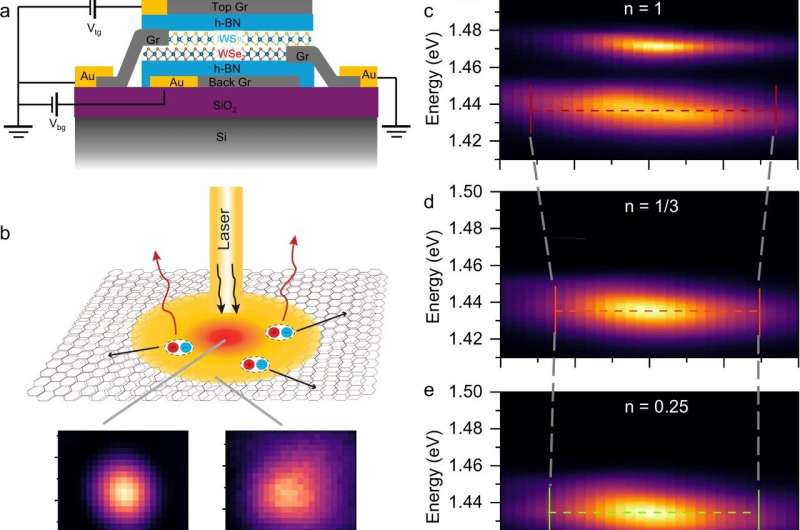
A team of researchers from Carnegie Mellon University, UC Riverside, and other institutions has made significant strides in controlling the flow of excitons within moiré superlattices. This innovative approach, detailed in a paper published in Nature Communications on December 21, 2025, showcases how correlated electrons can be leveraged to enhance exciton transport in layered materials.
Excitons, which are pairs of bound negatively charged electrons and positively charged holes, are vital for energy transport in semiconductors. These pairs also appear in transition metal dichalcogenides—thin materials made of a transition metal and two chalcogen atoms. The study explores how stacking two such layers with a slight rotational mismatch creates a moiré superlattice that can influence exciton dynamics.
Innovative Techniques in Moiré Superlattices
The research team, led by Sufei Shi, senior author of the study, focused on the WS2/WSe2 system to investigate quantum phenomena arising from strong interactions between electrons and excitons. “Even back in 2021, we discovered the strong electron-electron interaction, which inspired us to manipulate exciton dynamics,” Shi explained.
To create the moiré superlattice, the researchers precisely stacked transition metal dichalcogenide layers at specific angles. By employing optical techniques, they prompted exciton formation between these layers. The team then adjusted the density of electrons within the superlattice to measure how far and quickly excitons could travel, a property known as diffusivity.
The findings revealed that when the density of electrons reached a threshold sufficient to form a Mott insulator state, the diffusivity of excitons was enhanced by an astonishing factor of up to 100. Conversely, in conditions where electrons organized into a rigid, crystal-like structure, referred to as Wigner crystal states, the exciton flow was significantly suppressed.
Implications for Quantum Devices and Optoelectronics
This breakthrough presents a new methodology for improving exciton diffusivity in transition metal dichalcogenide-based moiré superlattices. Shi noted that the potential applications extend to engineering specific excitonic states in future quantum and optoelectronic devices. “With the robust exciton in 2D semiconductors, there is a growing interest in utilizing excitons as information carriers instead of electrons,” he stated.
One challenge has been that excitons are charge-neutral and do not respond easily to electric fields, unlike electrons. The team’s ability to modulate exciton diffusivity through the interactions of correlated electrons represents a significant advancement in the field. Future research may build on these findings, exploring ways to further manipulate exciton flow using electric fields or nanoscale device patterns.
Shi emphasized the importance of this work: “We are also interested in how exciton-exciton interactions can be harnessed to manipulate exciton diffusion.” The ongoing research aims to deepen understanding of interlayer exciton diffusivity and its experimental modulation, paving the way for innovative technologies based on moiré superlattices.
As the field evolves, insights from this study could inspire new avenues for research and technology development, expanding the applications of excitons in electronic devices.

Dr. Michael Mosley’s Evening Eating Tip Helps Women Lose Weight

Montenegro’s Health System Faces Corruption Challenges, Report Finds

Washington D.C. Faces Turmoil: Record Shutdown, Tariffs, and Policies

Astronomers Identify Nine Signals from 3I/ATLAS as Human Noise

Buducnost Voli Dominates Mega 100-82 Ahead of Key Match

Beckham Family Celebrates Christmas Without Brooklyn, Shares Festive Moments

Exhaustion Unmasked: Rachel Christensen’s Hidden Health Battle

Navigate Your Rights on Unwanted Christmas Gifts with Ease

European Nations Reinforce Military Service Amid Rising Tensions

Andrew Pierce Confirms Departure from ITV’s Good Morning Britain

Neurologist Warns Excessive Use of Supplements Can Harm Brain

Fiona Phillips’ Husband Shares Heartfelt Update on Her Alzheimer’s Journey

Brian Cox Addresses Claims of Alien Probe in 3I/ATLAS Discovery

NASA Investigates Unusual Comet 3I/ATLAS; New Findings Emerge

Gogglebox Star Helena Worthington Announces Break After Loss

Scientists Examine 3I/ATLAS: Alien Artifact or Cosmic Oddity?

Tess Daly Honoured with MBE, Announces Departure from Strictly

Lewis Cope Addresses Accusations of Dance Training Advantage
-
 Entertainment2 weeks ago
Andrew Pierce Confirms Departure from ITV’s Good Morning Britain
-
 Health4 months ago
Neurologist Warns Excessive Use of Supplements Can Harm Brain
-
 Health4 months ago
Fiona Phillips’ Husband Shares Heartfelt Update on Her Alzheimer’s Journey
-
 Science2 months ago
Brian Cox Addresses Claims of Alien Probe in 3I/ATLAS Discovery
-
 Science2 months ago
NASA Investigates Unusual Comet 3I/ATLAS; New Findings Emerge
-
 Entertainment1 week ago
Gogglebox Star Helena Worthington Announces Break After Loss
-
 Science2 months ago
Scientists Examine 3I/ATLAS: Alien Artifact or Cosmic Oddity?
-
 Entertainment1 month ago
Tess Daly Honoured with MBE, Announces Departure from Strictly
-
 Entertainment3 months ago
Lewis Cope Addresses Accusations of Dance Training Advantage
-

 Entertainment5 months ago
Kerry Katona Discusses Future Baby Plans and Brian McFadden’s Wedding
-

 Science2 months ago
NASA Investigates Speedy Object 3I/ATLAS, Sparking Speculation
-

 Entertainment5 months ago
Emmerdale Faces Tension as Dylan and April’s Lives Hang in the Balance