
Science
Ancient Comet 3I/ATLAS Dazzles with Rare Insights as It Approaches Earth

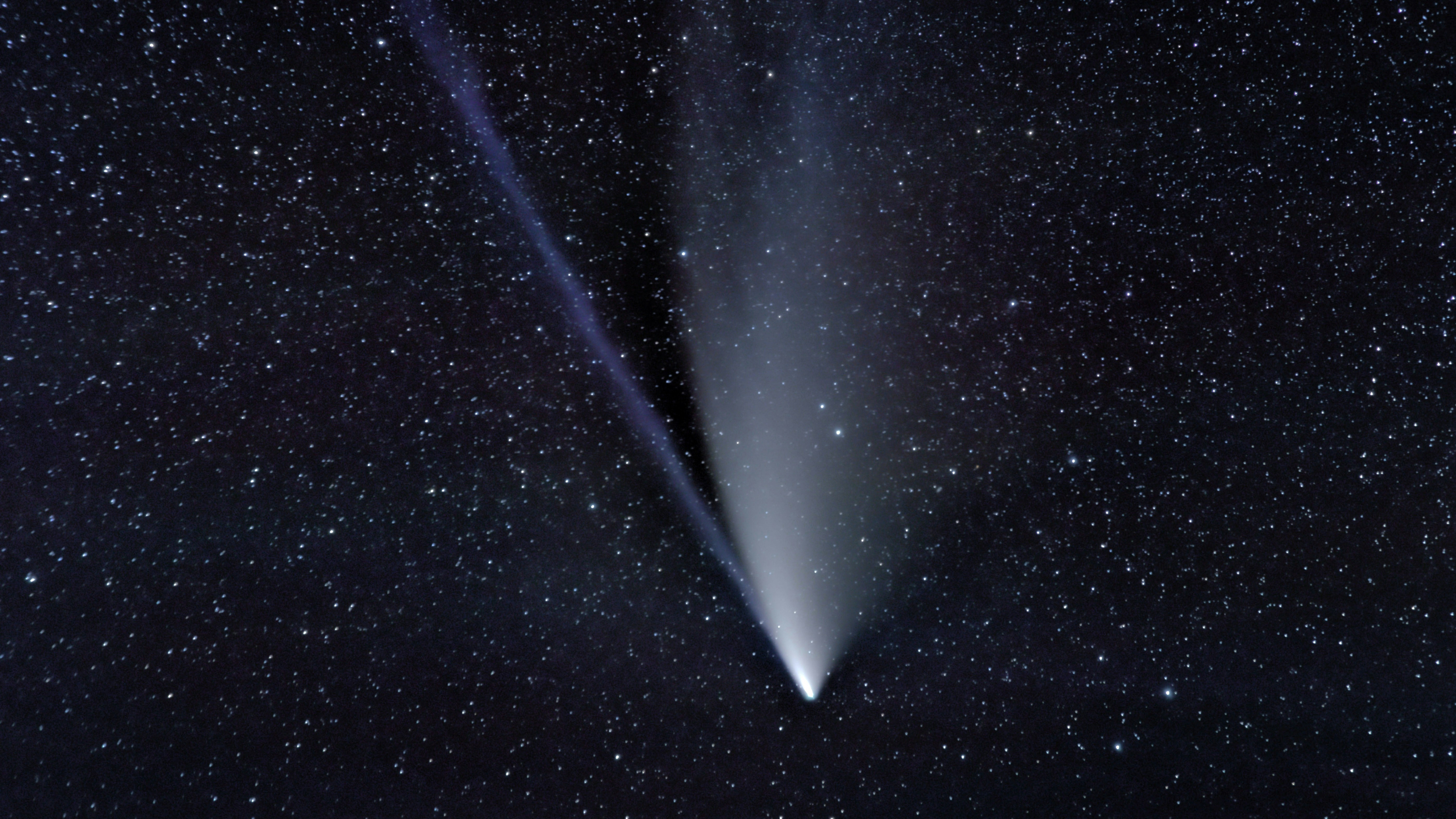
A comet from beyond our solar system, known as 3I/ATLAS, is captivating astronomers as it travels through the solar system. This interstellar visitor is currently ejecting bright jets and a substantial gas cloud, providing a unique opportunity for scientific study. Observations indicate that the comet may offer crucial insights into the building blocks of planets, challenging existing theories regarding the composition of celestial bodies.
The Hubble Space Telescope captured images of 3I/ATLAS on July 21, 2025, revealing a teardrop-shaped dust cocoon surrounding its icy nucleus. This characteristic confirms its identity as a comet rather than an asteroid. Further examinations suggest the nucleus measures between approximately 440 meters and 5.6 kilometers across. Its interstellar origin makes 3I/ATLAS a valuable specimen of ancient matter from outside our solar system.
In August 2025, observations from the James Webb Space Telescope unveiled a surprising composition of the gas cloud enveloping the comet. The cloud is predominantly made of carbon dioxide (CO2), with a CO2-to-water ratio of about 8:1, one of the highest ratios recorded for a comet. Alongside CO2, water ice, water vapor, and carbon monoxide (CO) were also detected. Spectroscopic analysis from Earth-based telescopes indicated weak emissions of cyanide (CN), and a depletion of carbon-chain molecules compared to typical solar system comets. Such findings imply that the comet’s nucleus has likely undergone extensive processing due to cosmic-ray exposure over billions of years, supporting its deep interstellar origins.
International Observations and Upcoming Approaches
The scientific community has mobilized its resources to study 3I/ATLAS. Multiple spacecraft operated by NASA and the European Space Agency (ESA), including the Lucy Spacecraft, MAVEN, and the Mars Reconnaissance Orbiter (MRO), have contributed data as the comet passed by Mars and the Sun. Its closest approach to Mars occurred in October 2025, when it came within approximately 30 million kilometers of the planet. This proximity allowed orbiters to capture ultraviolet images of the comet’s coma.
On November 19, 2025, NASA hosted a livestreamed event to showcase the data collected, which had been delayed due to a US government shutdown. Unlike comets originating from within our solar system that bear the chemical fingerprints of the early Sun’s environment, 3I/ATLAS offers a direct sample of a different star system’s composition. Its elevated CO2 levels and depleted carbon chains may indicate formative conditions that diverge from those found in our own solar system.
According to Amit Kshatriya, a NASA scientist, current observations confirm that 3I/ATLAS is indeed a comet and not an alien spacecraft. He noted, “It looks and behaves like a comet … but this one came from outside our solar system, which makes it fascinating, exciting, and scientifically very important.”
As 3I/ATLAS continues its journey, it is expected to make its closest approach to Earth on December 19, 2025, at a distance of approximately 270 million kilometers (about 170 million miles). While this distance is safe, it will allow for enhanced data collection by ground-based and space-based telescopes as the comet heads back into interstellar space. The ongoing observations of 3I/ATLAS not only promise to deepen our understanding of cometary science but also enrich the broader narrative of our solar system’s origins and the conditions that shape planetary systems across the galaxy.

Interstellar Visitor 3I/ATLAS Could Seed Life on Earth

Woman Sentenced to Four Years for Blackmailing Son Heung-min

Indonesia Faces $3.11 Billion Reconstruction After Fatal Floods

Shetland Islands Council Faces Backlash Over £9,500 Report

Trump Signals Potential Intervention in $72 Billion Netflix-Warner Merger

Surge in Under-18s Using Snus Raises Health Concerns

Renowned Physicist Ivica Puljak Discusses Cosmos and Life Beyond Earth

Swinney Declares Independence a Fresh Start for Scotland

Massive Sunspot Aimed at Earth Sparks Caution Among Experts

Neurologist Warns Excessive Use of Supplements Can Harm Brain

Fiona Phillips’ Husband Shares Heartfelt Update on Her Alzheimer’s Journey

Brian Cox Addresses Claims of Alien Probe in 3I/ATLAS Discovery

NASA Investigates Unusual Comet 3I/ATLAS; New Findings Emerge

Scientists Examine 3I/ATLAS: Alien Artifact or Cosmic Oddity?

Lewis Cope Addresses Accusations of Dance Training Advantage

Kerry Katona Discusses Future Baby Plans and Brian McFadden’s Wedding

NASA Investigates Speedy Object 3I/ATLAS, Sparking Speculation

Emmerdale Faces Tension as Dylan and April’s Lives Hang in the Balance
-
 Health3 months ago
Neurologist Warns Excessive Use of Supplements Can Harm Brain
-
 Health3 months ago
Fiona Phillips’ Husband Shares Heartfelt Update on Her Alzheimer’s Journey
-
 Science2 months ago
Brian Cox Addresses Claims of Alien Probe in 3I/ATLAS Discovery
-
 Science2 months ago
NASA Investigates Unusual Comet 3I/ATLAS; New Findings Emerge
-
 Science1 month ago
Scientists Examine 3I/ATLAS: Alien Artifact or Cosmic Oddity?
-
 Entertainment2 months ago
Lewis Cope Addresses Accusations of Dance Training Advantage
-
 Entertainment5 months ago
Kerry Katona Discusses Future Baby Plans and Brian McFadden’s Wedding
-
 Science1 month ago
NASA Investigates Speedy Object 3I/ATLAS, Sparking Speculation
-
 Entertainment4 months ago
Emmerdale Faces Tension as Dylan and April’s Lives Hang in the Balance
-

 World3 months ago
Cole Palmer’s Cryptic Message to Kobbie Mainoo Following Loan Talks
-
 Science1 month ago
NASA Scientists Explore Origins of 3I/ATLAS, a Fast-Moving Visitor
-

 Entertainment4 months ago
Major Cast Changes at Coronation Street: Exits and Returns in 2025