
Science
Interstellar Visitor 3I/ATLAS Could Seed Life on Earth


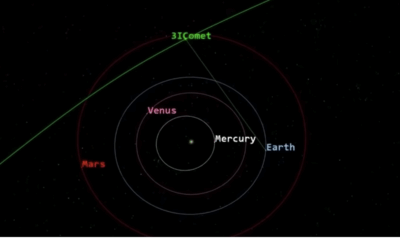
A theoretical physicist has raised concerns about a mysterious interstellar object, known as 3I/ATLAS, which may be on a trajectory to Earth. According to Avi Loeb, a professor of science at Harvard University, this object could potentially carry the building blocks of life, such as methanol and hydrogen cyanide, as it approaches our planet at speeds of 130,000 mph. Loeb describes this scenario as a “blind date” with an entity that could either “seed life” or pose a significant threat.
Loeb highlights that the chemical composition of 3I/ATLAS is noteworthy. The presence of methanol and hydrogen cyanide suggests that this object may have implications for the origins of life on Earth. In a blog post, he elaborated, “Methanol is a building block for amino acids and sugars, which are fundamental to the organic chemistry of life as we know it.” He believes that microorganisms, known as methylotrophs, can utilize methanol as their primary energy source, indicating its potential role in supporting life.
While many of Loeb’s colleagues view 3I/ATLAS as a harmless comet, he remains cautious. He draws attention to the possibility that it could serve as a vehicle for interstellar panspermia—a theory suggesting that life can be transferred between planets through space. He stated, “On a blind date with an interstellar visitor, it is prudent to observe the dating partner and decide whether it could have seeded life on Earth.”
Loeb’s concerns are not unwarranted. He points out the historical use of hydrogen cyanide as a chemical weapon during World War I, cautioning that while it is toxic at high concentrations, it also functions as an important signaling molecule at lower levels in various organisms. He noted, “The chemical properties of hydrogen cyanide allow it to serve as a precursor for the formation of complex organic molecules, such as amino acids and nucleic acid bases like adenine.”
3I/ATLAS, measuring approximately 12 miles in diameter, is expected to come closest to Earth on December 19, 2023. This encounter may represent one of the most significant close approaches we have had with an interstellar object, prompting discussions about the potential for alien life and advanced technology.
In his earlier remarks made in November, Loeb emphasized the need for world leaders to prepare for various scenarios, given the uncertainties surrounding this object. His unique perspective has sparked debate within the scientific community, as he continues to advocate for a proactive approach to understanding interstellar visitors.
As the date approaches, the scientific community watches closely, weighing the implications of 3I/ATLAS and what it may reveal about the broader universe and the origins of life on Earth. The conversation around this interstellar visitor underscores the importance of ongoing research and open dialogue in the quest for knowledge about our cosmic surroundings.

Interstellar Visitor 3I/ATLAS Could Seed Life on Earth

Woman Sentenced to Four Years for Blackmailing Son Heung-min

Indonesia Faces $3.11 Billion Reconstruction After Fatal Floods

Shetland Islands Council Faces Backlash Over £9,500 Report

Trump Signals Potential Intervention in $72 Billion Netflix-Warner Merger

Surge in Under-18s Using Snus Raises Health Concerns

Renowned Physicist Ivica Puljak Discusses Cosmos and Life Beyond Earth

Swinney Declares Independence a Fresh Start for Scotland

Massive Sunspot Aimed at Earth Sparks Caution Among Experts

Neurologist Warns Excessive Use of Supplements Can Harm Brain

Fiona Phillips’ Husband Shares Heartfelt Update on Her Alzheimer’s Journey

Brian Cox Addresses Claims of Alien Probe in 3I/ATLAS Discovery

NASA Investigates Unusual Comet 3I/ATLAS; New Findings Emerge

Scientists Examine 3I/ATLAS: Alien Artifact or Cosmic Oddity?

Lewis Cope Addresses Accusations of Dance Training Advantage

Kerry Katona Discusses Future Baby Plans and Brian McFadden’s Wedding

NASA Investigates Speedy Object 3I/ATLAS, Sparking Speculation

Emmerdale Faces Tension as Dylan and April’s Lives Hang in the Balance
-
 Health3 months ago
Neurologist Warns Excessive Use of Supplements Can Harm Brain
-
 Health3 months ago
Fiona Phillips’ Husband Shares Heartfelt Update on Her Alzheimer’s Journey
-
 Science2 months ago
Brian Cox Addresses Claims of Alien Probe in 3I/ATLAS Discovery
-
 Science2 months ago
NASA Investigates Unusual Comet 3I/ATLAS; New Findings Emerge
-
 Science1 month ago
Scientists Examine 3I/ATLAS: Alien Artifact or Cosmic Oddity?
-
 Entertainment2 months ago
Lewis Cope Addresses Accusations of Dance Training Advantage
-
 Entertainment5 months ago
Kerry Katona Discusses Future Baby Plans and Brian McFadden’s Wedding
-
 Science1 month ago
NASA Investigates Speedy Object 3I/ATLAS, Sparking Speculation
-
 Entertainment4 months ago
Emmerdale Faces Tension as Dylan and April’s Lives Hang in the Balance
-

 World3 months ago
Cole Palmer’s Cryptic Message to Kobbie Mainoo Following Loan Talks
-
 Science1 month ago
NASA Scientists Explore Origins of 3I/ATLAS, a Fast-Moving Visitor
-

 Entertainment4 months ago
Major Cast Changes at Coronation Street: Exits and Returns in 2025