
World
Exam Chief Resigns After Controversial English Test Fails Students

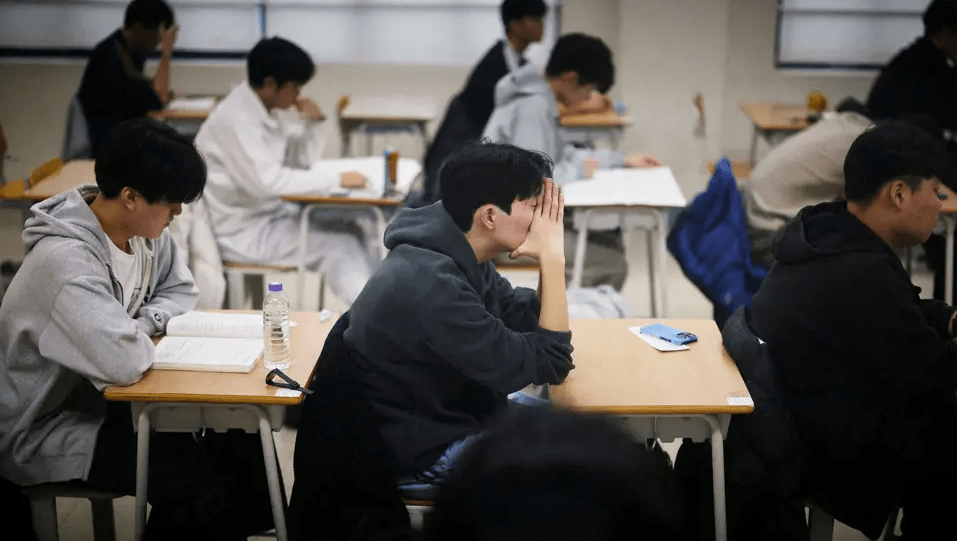
The chief of South Korea’s educational assessment body, Oh Seung-keol, has resigned following widespread criticism of this year’s English section of the annual college entrance exam, known as Suneung. The exam, notorious for its difficulty, has faced backlash for being excessively confusing, leading to claims that it is nearly impossible to pass.
Backlash Over Test Difficulty
The Suneung, an eight-hour examination held each November, serves as a crucial gateway for students seeking admission to top universities in South Korea. It is considered a pivotal factor for social mobility and economic stability. Students often begin preparing for this exam at a young age, with many attending private tutoring centers, commonly referred to as “cram schools,” starting as early as four years old.
This year’s exam has been particularly controversial due to alarming results from the English section, where only 3% of students achieved top marks. This figure marks a decline from the 6% who scored highly the previous year, representing the lowest pass rate since the introduction of absolute grading in 2018. Students were given just 70 minutes to tackle 45 questions, leading to significant frustration among test-takers.
In a statement, Oh acknowledged the backlash, apologizing for the distress caused to students and their families. He admitted that the test questions were “inappropriate” despite multiple rounds of editing designed to improve clarity. The Korea’s Institute for Curriculum and Evaluation also issued an apology, emphasizing its commitment to addressing concerns regarding the exam’s difficulty and its impact on students’ academic burdens.
Extreme Measures and Educational Pressure
The pressure surrounding the Suneung is so intense that flights are grounded nationwide for 35 minutes during the English listening section to minimize distractions. This extreme focus on academic performance has been linked to rising rates of depression and suicide among teenagers in South Korea, highlighting the urgent need for reform in the education system.
Professor Jung Chae-kwan, an English language educator, commented on the situation, stating that while the test is not impossible, it is indeed “maddeningly confusing.” He noted that many educators focus on teaching test-taking strategies rather than fostering genuine language proficiency, which further complicates students’ experiences with the exam.
The complexity of the exam questions was exemplified by two notable items. One question required students to determine the correct placement of a sentence within a paragraph discussing virtual reality in video games. Another asked them to analyze the political philosophies of Immanuel Kant and Thomas Hobbes regarding the rule of law, a task that demanded a deep understanding of complex theoretical concepts.
As South Korea reflects on the implications of this year’s Suneung, the focus shifts to potential reforms that could alleviate the intense pressure on students while ensuring that assessments are both fair and constructive. The challenge remains significant, as educational authorities navigate the delicate balance between maintaining rigorous academic standards and protecting the mental well-being of students.

FDA Plans New Warning for Covid Vaccines Following Heart Damage Study

Lochaber Women’s Aid Hosts Reclaim the Night Walk for Safety

New Research Reveals Effective Injection Method to Control Starfish

Thomas Frank Praises Dyche’s Understanding Ahead of Spurs Clash

Manchester United Faces Injury Challenges Before Bournemouth Match

Breaking Free: A Woman’s Journey Through Industry Toxicity

Education Ministry Partners to Combat Gambling Risks for Students

Montenegro’s Civil Initiative Responds to Serbian Church Criticism

Global Report Reveals Alarming Decline in Human Rights Standards

Neurologist Warns Excessive Use of Supplements Can Harm Brain

Fiona Phillips’ Husband Shares Heartfelt Update on Her Alzheimer’s Journey

Brian Cox Addresses Claims of Alien Probe in 3I/ATLAS Discovery

NASA Investigates Unusual Comet 3I/ATLAS; New Findings Emerge

Scientists Examine 3I/ATLAS: Alien Artifact or Cosmic Oddity?

Lewis Cope Addresses Accusations of Dance Training Advantage

Kerry Katona Discusses Future Baby Plans and Brian McFadden’s Wedding

NASA Investigates Speedy Object 3I/ATLAS, Sparking Speculation

Emmerdale Faces Tension as Dylan and April’s Lives Hang in the Balance
-
 Health3 months ago
Neurologist Warns Excessive Use of Supplements Can Harm Brain
-
 Health4 months ago
Fiona Phillips’ Husband Shares Heartfelt Update on Her Alzheimer’s Journey
-
 Science2 months ago
Brian Cox Addresses Claims of Alien Probe in 3I/ATLAS Discovery
-
 Science2 months ago
NASA Investigates Unusual Comet 3I/ATLAS; New Findings Emerge
-
 Science2 months ago
Scientists Examine 3I/ATLAS: Alien Artifact or Cosmic Oddity?
-
 Entertainment2 months ago
Lewis Cope Addresses Accusations of Dance Training Advantage
-
 Entertainment5 months ago
Kerry Katona Discusses Future Baby Plans and Brian McFadden’s Wedding
-
 Science2 months ago
NASA Investigates Speedy Object 3I/ATLAS, Sparking Speculation
-
 Entertainment5 months ago
Emmerdale Faces Tension as Dylan and April’s Lives Hang in the Balance
-

 World3 months ago
Cole Palmer’s Cryptic Message to Kobbie Mainoo Following Loan Talks
-

 World4 weeks ago
Bailey and Rebecca Announce Heartbreaking Split After MAFS Reunion
-

 Science2 months ago
NASA Scientists Explore Origins of 3I/ATLAS, a Fast-Moving Visitor