
Science
Roman Mosaic in Rutland Reveals Unexpected Aeschylus Influence

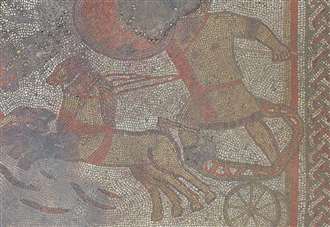
A remarkable Roman mosaic discovered in a farmer’s field in Rutland has unveiled an unexpected connection to ancient Greek drama. In 2020, farmer Jim Irvine stumbled upon the mosaic in his father’s field, leading to its excavation by experts from the University of Leicester Archaeological Services (ULAS). This mosaic is believed to be part of a Roman villa complex and has garnered attention as the first in the UK to depict scenes from Homer’s The Iliad, making it one of the few known examples in Europe.
Featuring prominently on the BBC Two show Digging for Britain, hosted by Professor Alice Roberts, the mosaic illustrates three pivotal moments between the Greek hero Achilles and the Trojan prince Hector: their duel, the dragging of Hector’s body, and its subsequent ransom by King Priam. Recently, however, new research has reinterpreted these scenes.
A New Perspective on the Mosaic
Research led by Dr Jane Masséglia, an Associate Professor in Ancient History at the University of Leicester, has revealed that the mosaic does not simply follow Homer’s narrative. Instead, it draws from a lesser-known version of the Trojan War story as told by the Greek playwright Aeschylus. In her study published in the journal Britannia 2025, Dr Masséglia states, “Not only have we got scenes telling the Aeschylus version of the story, but the top panel is actually based on a design used on a Greek pot that dates from the time of Aeschylus, 800 years before the mosaic was laid.”
Dr Masséglia’s observations point to the influence of older artistic standards across various cultures, noting that several elements of the mosaic are reminiscent of designs found in ancient silverware, coins, and pottery from regions such as Greece, Turkey, and Gaul. “Here we’ve got Roman British craftsmanship but a Mediterranean heritage of design,” she added.
Continued Research and Cultural Insights
The site where the mosaic was found is recognized as a scheduled monument, underscoring its national significance. Further excavations by Historic England and ULAS took place in 2021 and 2022, aiming to deepen the understanding of life in Roman Britain during the third and fourth centuries.
The villa is believed to have belonged to a wealthy citizen, suggesting a vibrant cultural exchange during this period. Jim Irvine, who has chronicled his discovery in a published book, reflects on the implications of the findings: “It’s a fascinating and important development that suggests Roman Britain may have been far more cosmopolitan than we often imagine.”
As the research unfolds, it promises to shed more light on the cultural landscape of Roman Britain, revealing connections that extend beyond local narratives. The mosaic stands not only as a testament to Roman artistry but also as a bridge to the broader tapestry of Mediterranean storytelling and influence.

Scientists Discover Unprecedented Cosmic Explosion in Space

Knežević Criticizes Government Wastewater Plant Guarantees

Volcanic Eruptions Linked to the Spread of the Black Death

Survey Reveals Declining Confidence in UK Rail Market

Rail Market Confidence Declines as Businesses Cut Staff

Claudia Winkleman Reveals Dance Partner Preference as Farewell Nears

Thermo Fisher Scientific Launches Integrated Drug Development Services

Discover 5 Iconic Quadjets Still Flying in Commercial Aviation

Cattle Prices Surge at Draperstown Mart with Strong Demand

Neurologist Warns Excessive Use of Supplements Can Harm Brain

Fiona Phillips’ Husband Shares Heartfelt Update on Her Alzheimer’s Journey

Brian Cox Addresses Claims of Alien Probe in 3I/ATLAS Discovery

NASA Investigates Unusual Comet 3I/ATLAS; New Findings Emerge

Scientists Examine 3I/ATLAS: Alien Artifact or Cosmic Oddity?

Lewis Cope Addresses Accusations of Dance Training Advantage

Kerry Katona Discusses Future Baby Plans and Brian McFadden’s Wedding

NASA Investigates Speedy Object 3I/ATLAS, Sparking Speculation

Emmerdale Faces Tension as Dylan and April’s Lives Hang in the Balance
-
 Health3 months ago
Neurologist Warns Excessive Use of Supplements Can Harm Brain
-
 Health4 months ago
Fiona Phillips’ Husband Shares Heartfelt Update on Her Alzheimer’s Journey
-
 Science2 months ago
Brian Cox Addresses Claims of Alien Probe in 3I/ATLAS Discovery
-
 Science2 months ago
NASA Investigates Unusual Comet 3I/ATLAS; New Findings Emerge
-
 Science2 months ago
Scientists Examine 3I/ATLAS: Alien Artifact or Cosmic Oddity?
-
 Entertainment2 months ago
Lewis Cope Addresses Accusations of Dance Training Advantage
-
 Entertainment5 months ago
Kerry Katona Discusses Future Baby Plans and Brian McFadden’s Wedding
-
 Science1 month ago
NASA Investigates Speedy Object 3I/ATLAS, Sparking Speculation
-
 Entertainment4 months ago
Emmerdale Faces Tension as Dylan and April’s Lives Hang in the Balance
-

 World3 months ago
Cole Palmer’s Cryptic Message to Kobbie Mainoo Following Loan Talks
-
 Science1 month ago
NASA Scientists Explore Origins of 3I/ATLAS, a Fast-Moving Visitor
-

 Entertainment4 months ago
Major Cast Changes at Coronation Street: Exits and Returns in 2025