
Science
Comet 3I/ATLAS Reveals CO2-Rich Chemistry, Insights into Star Systems

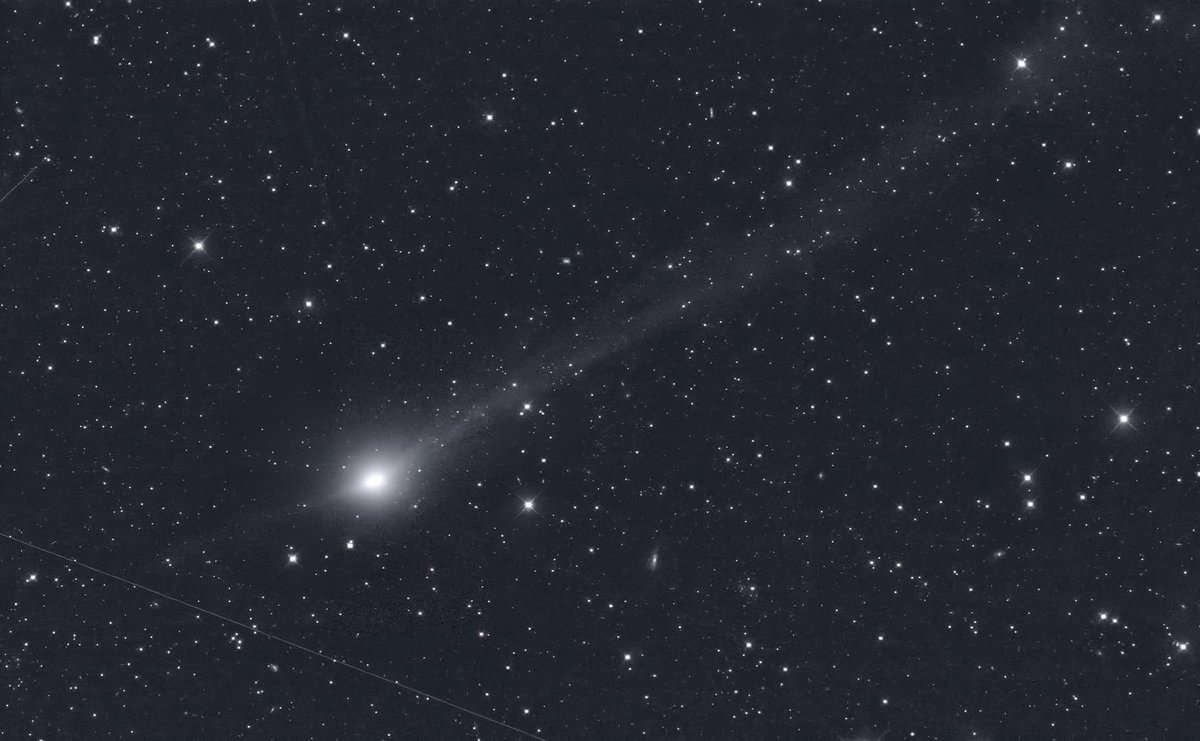
A rare interstellar visitor, Comet 3I/ATLAS, has provided scientists with unprecedented insights into its chemical composition, revealing a rich presence of carbon dioxide (CO2). As the comet moves away from Earth after its closest approach, researchers are analyzing the data to better understand conditions in distant star systems. Discovered by NASA’s ATLAS survey telescope in Chile, 3I/ATLAS is only the third confirmed interstellar object to pass through our solar system.
The comet’s hyperbolic trajectory, exceeding 57 km/s, guarantees it will not remain bound to the Sun, making its fleeting passage an exceptional opportunity for study. The most significant findings stem from infrared observations conducted by the James Webb Space Telescope (JWST), which detected a pronounced CO2 signature. This composition starkly contrasts with most solar-system comets, which tend to be water-rich. The higher fraction of carbon dioxide in 3I/ATLAS hints at the diversity of chemical environments found in other planetary systems.
Analyzing the Comet’s Unique Features
The CO2-rich coma of 3I/ATLAS presents a rare sample of extrasolar material, offering astronomers the chance to infer conditions from the comet’s home star system. Insights gained could refine existing models of planetary formation, especially in relation to the distribution of volatile compounds essential for the emergence of life.
Additional data was collected by NASA’s Europa Clipper, which utilized its Ultraviolet Spectrograph (Europa-UVS) to capture a unique ultraviolet perspective of 3I/ATLAS. This observation occurred when Earth and Mars tracking capabilities were limited. According to ScienceDaily, the Europa-UVS can identify fundamental transitions that indicate gas release and molecular breakup.
Researchers noted, “We can see gases come off the comet, and water molecules break apart into hydrogen and oxygen atoms.” These ultraviolet measurements enabled scientists to map the comet’s dust and plasma tails from an unusual angle. They observed outgassing patterns shortly after the comet’s perihelion, determining the speed and density of the ejected gases, which appear to interact significantly with solar radiation.
The European Space Agency’s JUICE mission, equipped with complementary ultraviolet capabilities, is expected to further assist in reconstructing the comet’s tail structure in three dimensions. This enhanced understanding will contribute additional clues about the forces influencing interstellar comets.
Ground-Based and Space Observations
Observing 3I/ATLAS from Earth posed challenges, particularly during its close approach to the Sun. To fill this observational gap, NASA’s Parker Solar Probe captured daily images from October 18 to November 5, 2025. The probe’s WISPR camera successfully navigated the intense solar glare to track the comet’s tail and dust emissions. These images represent a critical time series during which ground-based tracking was impossible, providing unprecedented insight into the comet’s behaviour near perihelion.
The close proximity to the Sun necessitated complex spacecraft manoeuvres and sophisticated image processing to filter out coronal brightness. The resulting data illustrate how the comet’s dust and gas interact with solar wind, offering researchers a rare glimpse into processes that may be common in other star systems but are seldom observable in real time.
X-ray observatories contributed another layer to the study. ESA’s XMM-Newton observed 3I/ATLAS on December 3, 2025, followed by Japan’s XRISM mission from November 26 to 28, 2025. These observations unveiled X-ray emissions stretching hundreds of thousands of kilometres from the comet’s nucleus, indicating interactions between solar-wind ions and neutral gases in the coma.
For amateur astronomers, 3I/ATLAS remains a telescope-only target with an estimated magnitude of 12.8 and is currently positioned near the constellation Leo. While faint, the comet continues to provide valuable scientific data, underscoring the importance of international collaboration in space exploration. Data from multiple spacecraft and observatories are being combined to create a comprehensive understanding of this interstellar visitor.

Niksic Celebrates Cultural Legacy with Folklore Milestone

NLC Demands Urgent Wage Adjustments Amid Rising Living Costs

‘One Battle After Another’ Triumphs with Six Oscars at 98th Academy Awards

Rainy Monday in Alton Clears for Sunshine by Midweek

Residents Push for New Supermarket in Overcrowded Town

Jimmy Kimmel Critiques Trump at 98th Academy Awards Ceremony

Young People Face Job Market Challenges Due to Health Issues

Stars Shine at the 2026 Oscars: Adorable Couples Take Center Stage

Brooklyn Beckham Faces Backlash for Mother’s Day Message Snub

Andrew Pierce Confirms Departure from ITV’s Good Morning Britain

Coronation Street Reveals Audrey Roberts’ Absence Explained

Fiona Phillips’ Husband Shares Heartfelt Update on Her Alzheimer’s Journey

Gogglebox Star Helena Worthington Announces Break After Loss

Neurologist Warns Excessive Use of Supplements Can Harm Brain

Brian Cox Addresses Claims of Alien Probe in 3I/ATLAS Discovery

NASA Investigates Unusual Comet 3I/ATLAS; New Findings Emerge

EastEnders Welcomes Back Mark Fowler Jr. with New Actor

Tess Daly Honoured with MBE, Announces Departure from Strictly
-
 Entertainment6 months ago
Andrew Pierce Confirms Departure from ITV’s Good Morning Britain
-
 Entertainment4 months ago
Coronation Street Reveals Audrey Roberts’ Absence Explained
-
 Health10 months ago
Fiona Phillips’ Husband Shares Heartfelt Update on Her Alzheimer’s Journey
-
 Entertainment6 months ago
Gogglebox Star Helena Worthington Announces Break After Loss
-
 Health9 months ago
Neurologist Warns Excessive Use of Supplements Can Harm Brain
-
 Science8 months ago
Brian Cox Addresses Claims of Alien Probe in 3I/ATLAS Discovery
-
 Science8 months ago
NASA Investigates Unusual Comet 3I/ATLAS; New Findings Emerge
-
 World5 months ago
EastEnders Welcomes Back Mark Fowler Jr. with New Actor
-
 Entertainment7 months ago
Tess Daly Honoured with MBE, Announces Departure from Strictly
-

 Health4 months ago
Gyles Brandreth Shares Heartfelt Journey Following Grandson’s Cancer Diagnosis
-

 Entertainment10 months ago
Major Cast Changes at Coronation Street: Exits and Returns in 2025
-

 World7 months ago
EastEnders’ Nicola Mitchell Faces Life-Changing Pregnancy Twist