
Science
Edinburgh Researchers Unveil Tech to Boost AI Speed Tenfold

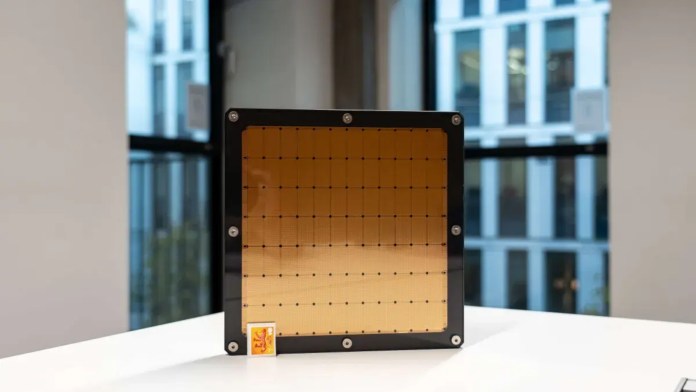
Researchers at the University of Edinburgh have developed a groundbreaking system that could enhance the speed of artificial intelligence (AI) data processing by a factor of ten. This advancement is expected to significantly impact industries reliant on large language models (LLMs), such as finance, healthcare, and customer service applications like chatbots.
The innovation is rooted in the use of wafer-scale computer chips, which are the largest of their kind and comparable in size to a medium chopping board. These chips can perform multiple calculations simultaneously due to their expansive on-chip memory and design. Currently, most AI systems utilize graphics processing units (GPUs) that are interconnected in networks, requiring data to traverse between different chips. This method can limit performance and efficiency.
WaferLLM: A New Era for AI Processing
The team at the University of Edinburgh has introduced a software solution specifically designed for wafer-scale chips, called WaferLLM. In tests conducted at the EPCC, a supercomputing centre at the university, the third-generation wafer-scale processors demonstrated a tenfold increase in response speed compared to a cluster of 16 GPUs. Additionally, these chips were found to be considerably more energy-efficient, consuming about half the energy of GPUs while operating LLMs.
According to Dr. Luo Mai, the lead researcher and reader at the university’s School of Informatics, the potential of wafer-scale computing has been remarkable, yet software limitations have hindered its practical application. He stated, “With WaferLLM, we show that the right software design can unlock that potential, delivering real gains in speed and energy efficiency for large language models.”
The research was peer-reviewed and presented at an operating systems and design symposium in July 2023. Professor Mark Parsons, director of EPCC and dean of research computing at the university, emphasized the significance of the findings, noting, “Dr. Mai’s work is truly ground-breaking and shows how the cost of inference can be massively reduced.”
Future Implications and Open-Source Accessibility
The implications of this research extend beyond immediate performance improvements. The team has made their findings available as open-source software, allowing other developers to create applications that leverage wafer-scale technology. This collaborative approach could foster innovation across various sectors that depend on rapid data analysis and real-time intelligence.
As industries increasingly rely on AI for critical decision-making processes, the advancements made by the University of Edinburgh could pave the way for a new generation of AI infrastructure capable of meeting the demands of modern society. The potential applications in science, healthcare, education, and everyday life are substantial, marking a significant step forward in the field of artificial intelligence.

Niksic Celebrates Cultural Legacy with Folklore Milestone

NLC Demands Urgent Wage Adjustments Amid Rising Living Costs

‘One Battle After Another’ Triumphs with Six Oscars at 98th Academy Awards

Rainy Monday in Alton Clears for Sunshine by Midweek

Residents Push for New Supermarket in Overcrowded Town

Jimmy Kimmel Critiques Trump at 98th Academy Awards Ceremony

Young People Face Job Market Challenges Due to Health Issues

Stars Shine at the 2026 Oscars: Adorable Couples Take Center Stage

Brooklyn Beckham Faces Backlash for Mother’s Day Message Snub

Andrew Pierce Confirms Departure from ITV’s Good Morning Britain

Coronation Street Reveals Audrey Roberts’ Absence Explained

Fiona Phillips’ Husband Shares Heartfelt Update on Her Alzheimer’s Journey

Gogglebox Star Helena Worthington Announces Break After Loss

Neurologist Warns Excessive Use of Supplements Can Harm Brain

Brian Cox Addresses Claims of Alien Probe in 3I/ATLAS Discovery

NASA Investigates Unusual Comet 3I/ATLAS; New Findings Emerge

EastEnders Welcomes Back Mark Fowler Jr. with New Actor

Tess Daly Honoured with MBE, Announces Departure from Strictly
-
 Entertainment6 months ago
Andrew Pierce Confirms Departure from ITV’s Good Morning Britain
-
 Entertainment3 months ago
Coronation Street Reveals Audrey Roberts’ Absence Explained
-
 Health9 months ago
Fiona Phillips’ Husband Shares Heartfelt Update on Her Alzheimer’s Journey
-
 Entertainment5 months ago
Gogglebox Star Helena Worthington Announces Break After Loss
-
 Health9 months ago
Neurologist Warns Excessive Use of Supplements Can Harm Brain
-
 Science7 months ago
Brian Cox Addresses Claims of Alien Probe in 3I/ATLAS Discovery
-
 Science7 months ago
NASA Investigates Unusual Comet 3I/ATLAS; New Findings Emerge
-
 World4 months ago
EastEnders Welcomes Back Mark Fowler Jr. with New Actor
-
 Entertainment6 months ago
Tess Daly Honoured with MBE, Announces Departure from Strictly
-

 Health4 months ago
Gyles Brandreth Shares Heartfelt Journey Following Grandson’s Cancer Diagnosis
-

 Entertainment9 months ago
Major Cast Changes at Coronation Street: Exits and Returns in 2025
-

 World7 months ago
EastEnders’ Nicola Mitchell Faces Life-Changing Pregnancy Twist