
Science
Magellanic Penguins Navigate Using Ocean Currents for Energy Efficiency

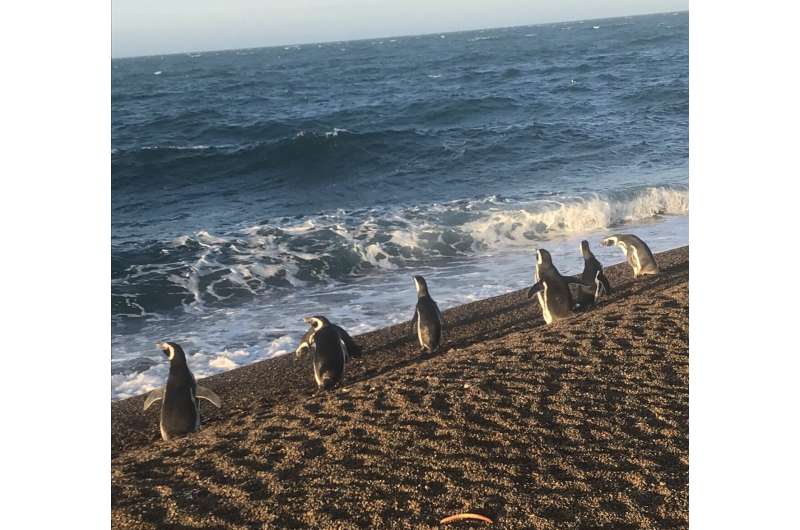
A recent study has revealed that Magellanic penguins may use ocean currents to optimize their energy expenditure during long foraging trips. Conducted by Richard Michael Gunner and his team at the Max-Planck-Institut für Verhaltensbiologie in Germany, the research was published in PLOS Biology on July 17, 2025. The findings suggest that these penguins can sense current drift and adjust their navigation strategies accordingly.
The study focused on understanding how Magellanic penguins navigate over vast distances without the aid of visible landmarks. The researchers fitted 27 adult penguins from the San Lorenzo Magellanic penguin colony in Peninsula Valdés, Argentina, with GPS and IMU loggers. Each penguin’s foraging trip was recorded before the devices were removed, allowing for an analysis of various movement parameters such as dive profiles, compass headings, speeds, and durations.
Findings indicate that during periods of calm currents, penguins maintained a direct route towards their colony. In contrast, when confronted with stronger currents, they adapted their swimming patterns to flow with the current. This strategy increased their travel distance but conserved energy, demonstrating an awareness of the current drift relative to their out-of-sight destination.
The researchers noted that while navigating under strong currents, the penguins displayed a more dispersed heading distribution. This behavior suggests that they engage in repeated adjustments to compensate for drift while still aiming toward their intended location. According to the authors, “Our results indicate that penguins notice discrepancies between their intended path and actual displacement over ground, then adjust accordingly.”
While these findings are significant, the researchers acknowledged that the study’s scope was limited to a single foraging trip for each of the 27 penguins. They emphasize the need for further investigations to replicate the results across different penguin populations and other marine species. Future studies may also explore the mechanisms by which penguins detect and adapt to varying ocean currents.
The authors highlight the intricate navigation abilities of Magellanic penguins, stating, “Magellanic penguins finding their way back to their nests from the open ocean subtly adjust their headings to exploit tidal currents, following paths that reduce energy costs while maintaining remarkable accuracy.” Rather than swimming directly home, these penguins drift laterally with the tides, balancing travel efficiency with opportunistic foraging along the way.
This research contributes valuable insights into the navigation strategies of marine animals, enhancing our understanding of how they interact with their environment to optimize energy use during long-distance travel. The study serves as a reminder of the complexity of animal behavior and the adaptability of species like the Magellanic penguin in the face of challenging conditions.

Niksic Celebrates Cultural Legacy with Folklore Milestone

NLC Demands Urgent Wage Adjustments Amid Rising Living Costs

‘One Battle After Another’ Triumphs with Six Oscars at 98th Academy Awards

Rainy Monday in Alton Clears for Sunshine by Midweek

Residents Push for New Supermarket in Overcrowded Town

Jimmy Kimmel Critiques Trump at 98th Academy Awards Ceremony

Young People Face Job Market Challenges Due to Health Issues

Stars Shine at the 2026 Oscars: Adorable Couples Take Center Stage

Brooklyn Beckham Faces Backlash for Mother’s Day Message Snub

Andrew Pierce Confirms Departure from ITV’s Good Morning Britain

Coronation Street Reveals Audrey Roberts’ Absence Explained

Fiona Phillips’ Husband Shares Heartfelt Update on Her Alzheimer’s Journey

Neurologist Warns Excessive Use of Supplements Can Harm Brain

Gogglebox Star Helena Worthington Announces Break After Loss

Brian Cox Addresses Claims of Alien Probe in 3I/ATLAS Discovery

NASA Investigates Unusual Comet 3I/ATLAS; New Findings Emerge

EastEnders Welcomes Back Mark Fowler Jr. with New Actor

Tess Daly Honoured with MBE, Announces Departure from Strictly
-
 Entertainment5 months ago
Andrew Pierce Confirms Departure from ITV’s Good Morning Britain
-
 Entertainment2 months ago
Coronation Street Reveals Audrey Roberts’ Absence Explained
-
 Health8 months ago
Fiona Phillips’ Husband Shares Heartfelt Update on Her Alzheimer’s Journey
-
 Health8 months ago
Neurologist Warns Excessive Use of Supplements Can Harm Brain
-
 Entertainment5 months ago
Gogglebox Star Helena Worthington Announces Break After Loss
-
 Science7 months ago
Brian Cox Addresses Claims of Alien Probe in 3I/ATLAS Discovery
-
 Science7 months ago
NASA Investigates Unusual Comet 3I/ATLAS; New Findings Emerge
-
 World4 months ago
EastEnders Welcomes Back Mark Fowler Jr. with New Actor
-
 Entertainment6 months ago
Tess Daly Honoured with MBE, Announces Departure from Strictly
-

 Health3 months ago
Gyles Brandreth Shares Heartfelt Journey Following Grandson’s Cancer Diagnosis
-

 World6 months ago
EastEnders’ Nicola Mitchell Faces Life-Changing Pregnancy Twist
-

 Health8 months ago
TOWIE Couple Sophie Kasaei and Jordan Brook Pursue Fertility Treatment Abroad