
Science
Researchers Break Record for Quantum Mechanics with Heavy Nanoparticles

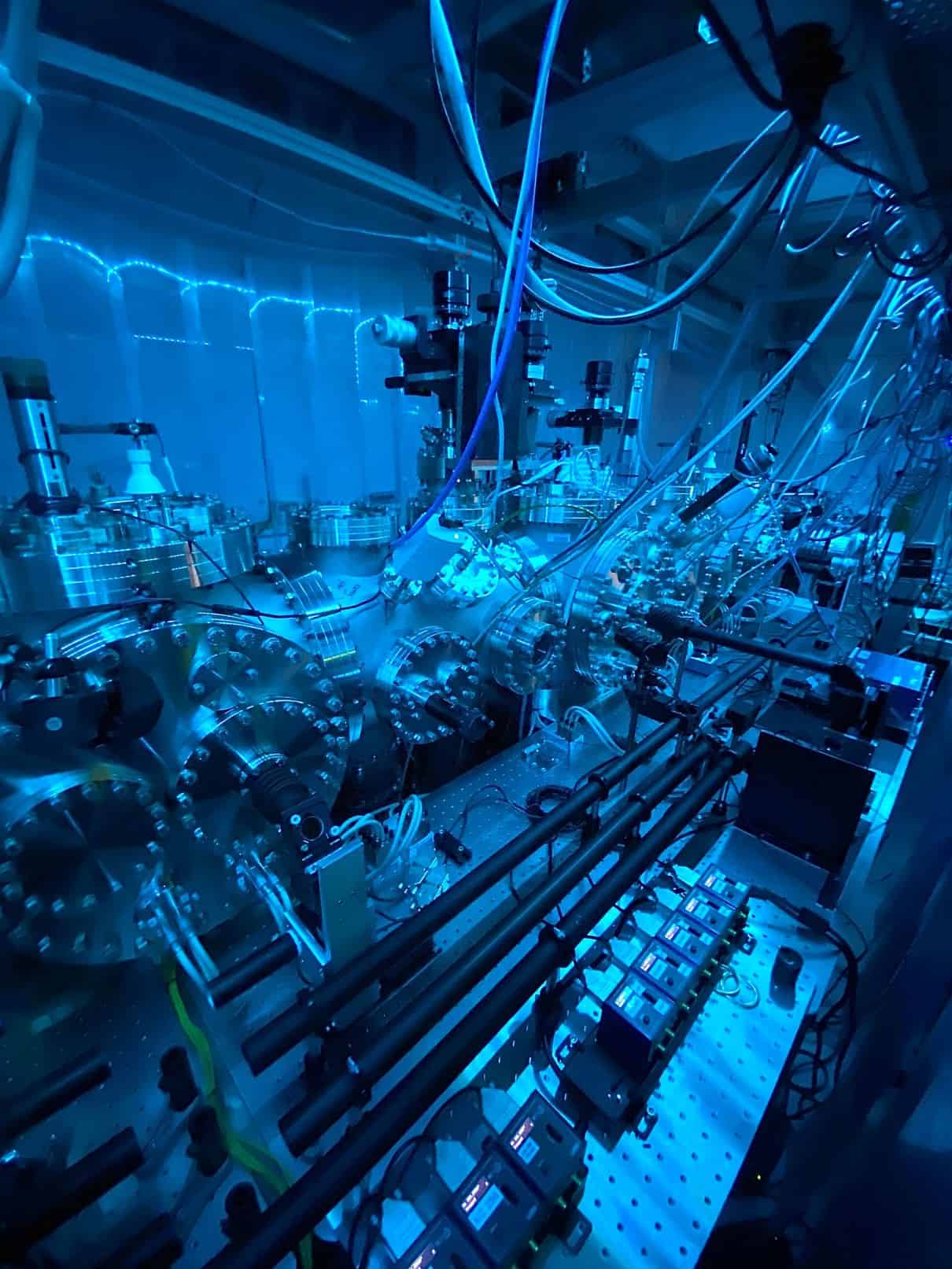
A team of researchers from Austria and Germany has significantly advanced the understanding of quantum mechanics by demonstrating that large metal nanoparticles, weighing over 170,000 atomic mass units, continue to exhibit quantum behavior. This breakthrough, detailed in the journal Nature, challenges the boundary between quantum and classical mechanics, raising questions about the fundamental nature of reality.
The study, led by Sebastian Pedalino, a PhD student at the University of Vienna, involved experiments that showcased the quantum properties of clusters of sodium atoms at extremely low temperatures. By utilizing a double-slit experiment, the researchers illustrated that these nanoparticles, which consist of thousands of atoms, remain governed by the principles of quantum mechanics even at macroscopic scales.
In the experiment, the team created clusters of sodium atoms in a helium-argon mixture at 77 K within an ultrahigh vacuum. Each cluster contained between 5,000 and 10,000 atoms, traveling at speeds around 160 m/s. This setup allowed the researchers to calculate the de Broglie wavelengths of the clusters, which ranged from 10‒22 femtometres.
To observe the matter-wave interference, the researchers employed an interferometer featuring three diffraction gratings designed with deep ultraviolet laser beams in a Talbot–Lau configuration. The first grating directed the clusters through narrow gaps, causing their wave function to expand. This wave function was then modulated by the second grating, resulting in observable interference patterns at the third grating. The outcome indicated that the clusters did not occupy a fixed position but instead existed in a superposition of locations, embodying what is known as a Schrödinger cat state. This term references the famous thought experiment by physicist Erwin Schrödinger, in which a cat in a sealed box is simultaneously alive and dead.
The researchers quantified their findings by calculating a measure known as macroscopicity, which combines the coherence time, mass of the object, and the degree of separation between states. Their results achieved a macroscopicity value of 15.5, an order of magnitude higher than previously recorded measurements in this field.
Markus Arndt, one of the lead researchers, emphasized the importance of this finding. He stated, “The motivation is simply that we do not yet know if quantum mechanics is the ultimate theory or if it requires any modification at some mass limit.” While some speculative theories suggest potential modifications to quantum mechanics, Arndt insists on the necessity of remaining open to experimental outcomes.
The sensitivity of their experimental setup to small forces may have broader implications. Arndt believes that this capability could be harnessed to explore material properties and possibly search for new particles in future experiments. He expressed both amazement and intrigue at the ability of these mesoscopic objects to exist in a delocalized state, stating, “The interpretation of this phenomenon, the duality between this delocalization and the apparently local nature in the act of measurement, is still an open conundrum.”
Looking ahead, the team plans to enhance their research by extending investigations to larger mass objects, increasing coherence times, and exploring various materials, including nanobiological substances and different metals. Arndt noted, “We still have a lot of work to do on sources, beam splitters, detectors, vibration isolation, and cooling. This is a big experimental adventure for us.”
This research not only pushes the boundaries of our understanding of quantum mechanics but also opens new avenues for scientific exploration in the field. The implications of such findings may reshape our comprehension of the quantum-classical divide, potentially leading to new technologies and insights into the fundamental laws of nature.

Niksic Celebrates Cultural Legacy with Folklore Milestone

NLC Demands Urgent Wage Adjustments Amid Rising Living Costs

‘One Battle After Another’ Triumphs with Six Oscars at 98th Academy Awards

Rainy Monday in Alton Clears for Sunshine by Midweek

Residents Push for New Supermarket in Overcrowded Town

Jimmy Kimmel Critiques Trump at 98th Academy Awards Ceremony

Young People Face Job Market Challenges Due to Health Issues

Stars Shine at the 2026 Oscars: Adorable Couples Take Center Stage

Brooklyn Beckham Faces Backlash for Mother’s Day Message Snub

Andrew Pierce Confirms Departure from ITV’s Good Morning Britain

Fiona Phillips’ Husband Shares Heartfelt Update on Her Alzheimer’s Journey

Neurologist Warns Excessive Use of Supplements Can Harm Brain

Gogglebox Star Helena Worthington Announces Break After Loss

Brian Cox Addresses Claims of Alien Probe in 3I/ATLAS Discovery

NASA Investigates Unusual Comet 3I/ATLAS; New Findings Emerge

EastEnders Welcomes Back Mark Fowler Jr. with New Actor

Coronation Street Reveals Audrey Roberts’ Absence Explained

Tess Daly Honoured with MBE, Announces Departure from Strictly
-
 Entertainment4 months ago
Andrew Pierce Confirms Departure from ITV’s Good Morning Britain
-
 Health7 months ago
Fiona Phillips’ Husband Shares Heartfelt Update on Her Alzheimer’s Journey
-
 Health7 months ago
Neurologist Warns Excessive Use of Supplements Can Harm Brain
-
 Entertainment4 months ago
Gogglebox Star Helena Worthington Announces Break After Loss
-
 Science6 months ago
Brian Cox Addresses Claims of Alien Probe in 3I/ATLAS Discovery
-
 Science6 months ago
NASA Investigates Unusual Comet 3I/ATLAS; New Findings Emerge
-
 World3 months ago
EastEnders Welcomes Back Mark Fowler Jr. with New Actor
-
 Entertainment1 month ago
Coronation Street Reveals Audrey Roberts’ Absence Explained
-
 Entertainment5 months ago
Tess Daly Honoured with MBE, Announces Departure from Strictly
-

 Health7 months ago
TOWIE Couple Sophie Kasaei and Jordan Brook Pursue Fertility Treatment Abroad
-

 World5 months ago
Bailey and Rebecca Announce Heartbreaking Split After MAFS Reunion
-

 Entertainment9 months ago
Coleen Nolan Reflects on Family Tragedy and Reconciliation