
Science
Researchers Enhance Detection of Multipartite Quantum Entanglement

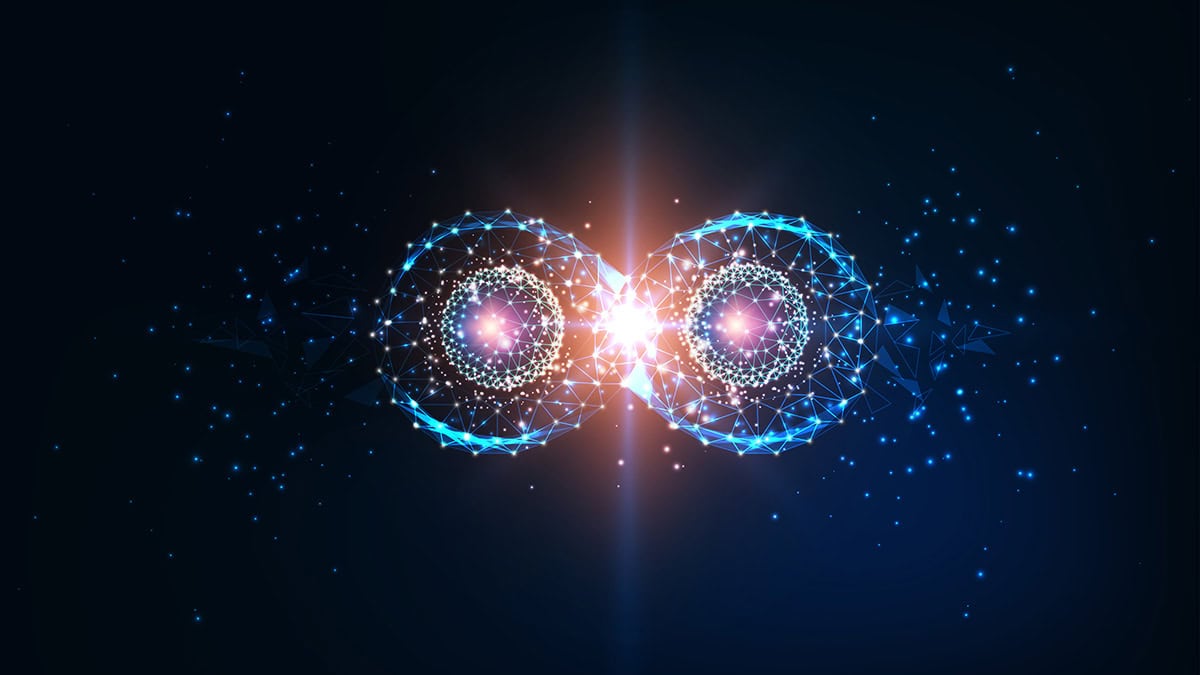
Recent advancements in quantum physics have significantly improved the ability to detect multipartite entanglement, a complex phenomenon essential for various quantum applications. Researchers, led by Jakub Szczepaniak, have developed enhanced entanglement witnesses that allow for verification of genuine multipartite entanglement even in challenging conditions, such as noisy, high-dimensional quantum states.
Genuine multipartite entanglement represents the most robust form of entanglement, where each part of a quantum system is entangled with every other part. This characteristic is vital for advanced quantum tasks, including quantum metrology and quantum error correction. In practical terms, researchers often rely on entanglement witnesses—measurable quantities that certify entanglement when they exceed a specified threshold.
The team’s innovative approach extends previous methods for constructing entanglement witnesses, broadening their applicability to a wider range of multipartite quantum states. By utilizing the multi-qudit stabiliser formalism, a framework commonly employed in quantum error correction, they can describe a significant number of both pure and mixed entangled states.
Their work generalizes prior results in two critical areas. First, it includes systems with arbitrary prime local dimensions, moving beyond the limitations of qubits. Second, it explores stabiliser subspaces, where the stabiliser not only defines a single state but encompasses entire entangled subspaces. This expansion enables the construction of witnesses specifically tailored to high-dimensional graph states and stabiliser-defined subspaces. Notably, these newly developed witnesses exhibit greater resilience to noise compared to those designed for multiqubit systems.
Particularly noteworthy are the witnesses tailored for GHZ-type states. These witnesses demonstrate the highest resistance to white noise, and the researchers identify instances where their construction yields the most noise-robust witness achievable. Furthermore, the study reveals that stabiliser-subspace witnesses can outperform graph-state witnesses when dealing with local dimensions exceeding two.
The implications of this research are profound. It offers more powerful and adaptable tools for detecting genuine multipartite entanglement in noisy and computationally relevant quantum systems. This advancement strengthens the ability to certify complex entanglement in real-world quantum technologies, potentially paving the way for future developments that extend beyond the stabiliser framework.
The findings are detailed in the article “Entanglement witnesses for stabilizer states and subspaces beyond qubits,” published in the Report on Progress in Physics in 2025. The study was part of a special focus on quantum entanglement, edited by Anna Sanpera and Carlo Marconi, which aims to explore the current state of the field and address open questions.
As quantum technologies continue to evolve, these new methodologies for detecting multipartite entanglement are likely to play a critical role in the advancement of quantum computing and related fields, illustrating the ongoing progress in understanding and harnessing the complexities of quantum mechanics.

Niksic Celebrates Cultural Legacy with Folklore Milestone

NLC Demands Urgent Wage Adjustments Amid Rising Living Costs

‘One Battle After Another’ Triumphs with Six Oscars at 98th Academy Awards

Rainy Monday in Alton Clears for Sunshine by Midweek

Residents Push for New Supermarket in Overcrowded Town

Jimmy Kimmel Critiques Trump at 98th Academy Awards Ceremony

Young People Face Job Market Challenges Due to Health Issues

Stars Shine at the 2026 Oscars: Adorable Couples Take Center Stage

Brooklyn Beckham Faces Backlash for Mother’s Day Message Snub

Andrew Pierce Confirms Departure from ITV’s Good Morning Britain

Fiona Phillips’ Husband Shares Heartfelt Update on Her Alzheimer’s Journey

Neurologist Warns Excessive Use of Supplements Can Harm Brain

Gogglebox Star Helena Worthington Announces Break After Loss

Brian Cox Addresses Claims of Alien Probe in 3I/ATLAS Discovery

NASA Investigates Unusual Comet 3I/ATLAS; New Findings Emerge

EastEnders Welcomes Back Mark Fowler Jr. with New Actor

Tess Daly Honoured with MBE, Announces Departure from Strictly

Coronation Street Reveals Audrey Roberts’ Absence Explained
-
 Entertainment4 months ago
Andrew Pierce Confirms Departure from ITV’s Good Morning Britain
-
 Health7 months ago
Fiona Phillips’ Husband Shares Heartfelt Update on Her Alzheimer’s Journey
-
 Health7 months ago
Neurologist Warns Excessive Use of Supplements Can Harm Brain
-
 Entertainment4 months ago
Gogglebox Star Helena Worthington Announces Break After Loss
-
 Science5 months ago
Brian Cox Addresses Claims of Alien Probe in 3I/ATLAS Discovery
-
 Science5 months ago
NASA Investigates Unusual Comet 3I/ATLAS; New Findings Emerge
-
 World2 months ago
EastEnders Welcomes Back Mark Fowler Jr. with New Actor
-
 Entertainment5 months ago
Tess Daly Honoured with MBE, Announces Departure from Strictly
-
 Entertainment1 month ago
Coronation Street Reveals Audrey Roberts’ Absence Explained
-

 Health7 months ago
TOWIE Couple Sophie Kasaei and Jordan Brook Pursue Fertility Treatment Abroad
-

 World5 months ago
Bailey and Rebecca Announce Heartbreaking Split After MAFS Reunion
-
 Entertainment9 months ago
Coleen Nolan Reflects on Family Tragedy and Reconciliation