
Science
Scientists Achieve Breakthrough in Quantum Signal Transmission to Satellites

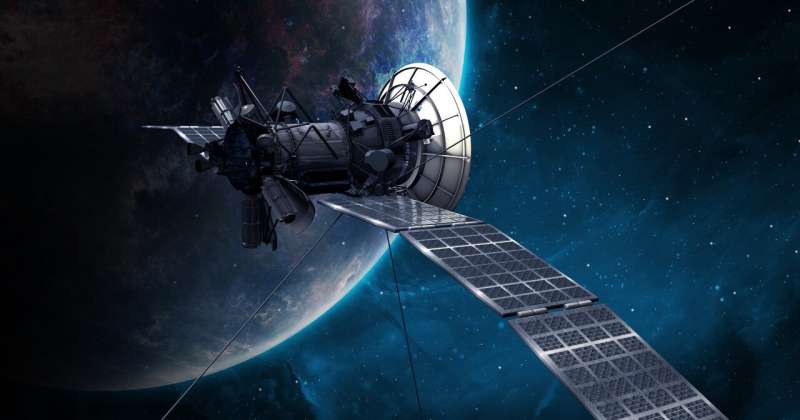
Recent research conducted by a team from the University of Technology Sydney has demonstrated the feasibility of transmitting quantum signals from Earth to a satellite, a concept previously deemed impractical. This significant advancement addresses major challenges in current quantum satellite communications, potentially paving the way for novel applications in secure data transmission.
The study, titled “Quantum entanglement distribution via uplink satellite channels,” was led by Professor Simon Devitt and Professor Alexander Solntsev, and published in the journal Physical Review Research. Current quantum satellites, like the Micius satellite, launched in 2016, have primarily focused on sending entangled particles of light down to ground stations. This new research expands the capabilities of quantum communications by proposing a method to send signals upward.
Traditionally, quantum satellites create entangled pairs in space, which are then transmitted to Earth. “Current quantum satellites create entangled pairs in space and then send each half of the pair down to two places on Earth—called a ‘downlink,’” explained Professor Solntsev. This process has been primarily used for cryptographic purposes, requiring only a few photons to establish a secure key. The idea of sending entangled photon pairs from the ground to a satellite had not been seriously considered due to concerns over signal loss and interference.
The research team conducted modeling to assess the viability of this uplink approach. They aimed to send two single particles of light from different ground stations to a satellite orbiting approximately 500 km above Earth at speeds nearing 20,000 km per hour. “Surprisingly, our modeling showed that an uplink is feasible,” said Professor Devitt. The team factored in real-world variables such as background light, atmospheric conditions, and potential misalignments in optical systems.
The findings suggest that testing the uplink concept could occur soon, utilizing drones or high-altitude balloons. This could facilitate the development of quantum networks spanning countries and continents, leveraging small low-orbit satellites. “A quantum internet is a very different beast from current nascent cryptographic applications,” noted Professor Devitt. “We need significantly more photons—more bandwidth—to connect quantum computers.”
The uplink method could provide the necessary bandwidth without the need for satellites to generate vast quantities of photons. Instead, a compact optical unit on the satellite could effectively interact with incoming photons and relay results, minimizing costs and size while enhancing practicality.
Looking ahead, Professor Devitt envisions a future where quantum entanglement functions similarly to electricity—an essential commodity that powers various applications. “There will be quantum devices that plug into an entanglement source as well as a power source, utilizing both to do something useful,” he stated.
This project exemplifies the collaborative efforts between the faculties of Engineering and IT and Science at UTS, showcasing how interdisciplinary cooperation can address significant technological challenges. The implications of this research extend beyond theoretical exploration, hinting at a future where quantum communications could revolutionize data security and connectivity on a global scale.
For more information, refer to the study published by S. Srikara et al in Physical Review Research.

Niksic Celebrates Cultural Legacy with Folklore Milestone

NLC Demands Urgent Wage Adjustments Amid Rising Living Costs

‘One Battle After Another’ Triumphs with Six Oscars at 98th Academy Awards

Rainy Monday in Alton Clears for Sunshine by Midweek

Residents Push for New Supermarket in Overcrowded Town

Jimmy Kimmel Critiques Trump at 98th Academy Awards Ceremony

Young People Face Job Market Challenges Due to Health Issues

Stars Shine at the 2026 Oscars: Adorable Couples Take Center Stage

Brooklyn Beckham Faces Backlash for Mother’s Day Message Snub

Andrew Pierce Confirms Departure from ITV’s Good Morning Britain

Coronation Street Reveals Audrey Roberts’ Absence Explained

Fiona Phillips’ Husband Shares Heartfelt Update on Her Alzheimer’s Journey

Neurologist Warns Excessive Use of Supplements Can Harm Brain

Gogglebox Star Helena Worthington Announces Break After Loss

Brian Cox Addresses Claims of Alien Probe in 3I/ATLAS Discovery

NASA Investigates Unusual Comet 3I/ATLAS; New Findings Emerge

EastEnders Welcomes Back Mark Fowler Jr. with New Actor

Tess Daly Honoured with MBE, Announces Departure from Strictly
-
 Entertainment5 months ago
Andrew Pierce Confirms Departure from ITV’s Good Morning Britain
-
 Entertainment2 months ago
Coronation Street Reveals Audrey Roberts’ Absence Explained
-
 Health8 months ago
Fiona Phillips’ Husband Shares Heartfelt Update on Her Alzheimer’s Journey
-
 Health8 months ago
Neurologist Warns Excessive Use of Supplements Can Harm Brain
-
 Entertainment5 months ago
Gogglebox Star Helena Worthington Announces Break After Loss
-
 Science7 months ago
Brian Cox Addresses Claims of Alien Probe in 3I/ATLAS Discovery
-
 Science7 months ago
NASA Investigates Unusual Comet 3I/ATLAS; New Findings Emerge
-
 World4 months ago
EastEnders Welcomes Back Mark Fowler Jr. with New Actor
-
 Entertainment6 months ago
Tess Daly Honoured with MBE, Announces Departure from Strictly
-
 Health3 months ago
Gyles Brandreth Shares Heartfelt Journey Following Grandson’s Cancer Diagnosis
-

 World6 months ago
EastEnders’ Nicola Mitchell Faces Life-Changing Pregnancy Twist
-

 Health8 months ago
TOWIE Couple Sophie Kasaei and Jordan Brook Pursue Fertility Treatment Abroad