
Politics
Gambia Accuses Myanmar of Genocide Against Rohingya in ICJ Case

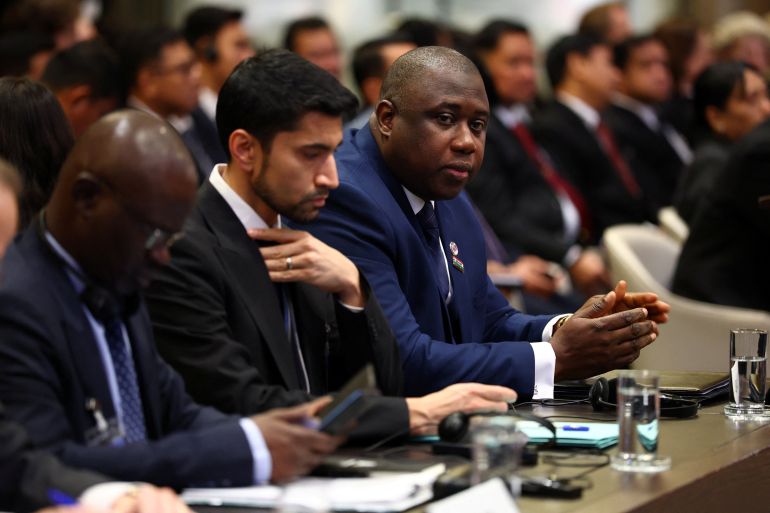
The Gambia has initiated a significant legal case against Myanmar, accusing the Southeast Asian nation of committing genocide against the Rohingya, a predominantly Muslim minority. This landmark hearing began at the International Court of Justice (ICJ) this week, with The Gambia’s Attorney General and Justice Minister, Dawda A Jallow, asserting that the Rohingya were “targeted for destruction” by Myanmar’s military government. The case comes nearly ten years after a military offensive in 2017 forced approximately 750,000 Rohingya to flee their homes, predominantly to Bangladesh.
As the final hearing opened on January 15, 2024, Jallow emphasized the systematic violence faced by the Rohingya, detailing accounts of mass killings, sexual violence, and arson attacks. This case is notable as it marks the first time allegations of mass violations against the Rohingya have been escalated to an international court. Additionally, it is unprecedented for the ICJ to adjudicate a genocide case brought by a third party on behalf of another group.
In a poignant moment, Jallow invited Rohingya refugees present in the court to stand and be acknowledged by the panel of judges. While these refugees are expected to provide testimonies in closed sessions, a timeline for a final ruling from the court remains uncertain. Although the ICJ does not have the power to enforce its decisions, its rulings carry considerable legal significance.
The implications of this case extend beyond The Gambia and Myanmar. Experts suggest that the court’s findings could influence a concurrent genocide case filed by South Africa against Israel, representing the Palestinian people.
Gambia’s Motivations for the Case
The Gambia filed its lawsuit against Myanmar in November 2019, alleging grave breaches of the 1948 Genocide Convention. The small West African nation, with a population of approximately 2.5 million, is a member of the Organisation for Islamic Cooperation (OIC). This advocacy for the Rohingya has thrust the nation into the global spotlight, particularly the case’s architect, Abubacarr Tambadou, who previously served as the country’s attorney general. After taking his role at the United Nations, he was nominated for the Nobel Peace Prize in 2021.
The Rohingya have faced persistent persecution in Myanmar, with violent military campaigns escalating particularly since late 2016. Reports from the United Nations indicated that around 10,000 Rohingya were killed and over 730,000 displaced following the military’s offensive. The UN’s fact-finding mission concluded that the military exhibited “genocidal intent” aimed at eradicating Rohingya identity.
Reflecting on The Gambia’s motivations, legal expert Imran Darboe, a former barrister with the Gambian justice ministry, noted that the country’s experience under former dictator Yahya Jammeh shaped its commitment to the Rohingya cause. Jammeh’s regime, which lasted from 1994 to 2017, was marked by oppression and human rights violations. Following his ousting, The Gambia began confronting its past through a truth and reconciliation commission, fostering a collective understanding of human rights issues.
Darboe added that the OIC’s backing may have mitigated financial burdens associated with such a complex legal battle.
The Argument Against Myanmar
During the ICJ proceedings, Jallow argued that the Rohingya have been “deliberately targeted” by Myanmar’s military regime, stating, “They have been targeted for destruction.” He described the horrific circumstances faced by the Rohingya, whose lives have been transformed into a “nightmare” due to extensive violence.
Legal representative Paul Reichler presented chilling testimonies describing violent incidents, including homes being set ablaze with occupants trapped inside and widespread sexual violence. He highlighted how Myanmar’s government has dehumanized the Rohingya, referring to them as an “impure and subhuman race.”
The case also includes input from Philippe Sands, who concluded that the scale of violence demonstrated clear genocidal intent by Myanmar.
Myanmar’s Defense
Myanmar’s legal team, led by Ko Ko Hlaing, the Minister of International Cooperation, is set to present its arguments beginning January 16, 2024. In the preliminary hearings from December 2019, Myanmar denied the allegations of genocide. Former leader Aung San Suu Kyi, who was ousted in a military coup in 2021, had described The Gambia’s claims as “incomplete and misleading.”
The ICJ had previously ordered Myanmar to undertake emergency measures to prevent further genocidal actions against the Rohingya, a decision that was viewed as a significant rebuke to Suu Kyi.
Despite the ongoing military control in Myanmar and its rejection of genocide claims, the government asserts that its military operations are aimed at combating armed groups, specifically targeting the Arakan Rohingya Salvation Army (ARSA).
The Rohingya Crisis
The Rohingya, primarily based in Myanmar’s western Rakhine State, have been subjected to severe discrimination and violence. Before their displacement, their population in Myanmar was around one million. They are classified as illegal migrants by the government, despite their claims of being Indigenous to the region.
Since 2016, violent crackdowns have forced hundreds of thousands to flee to neighboring countries, leading to an ongoing humanitarian crisis. Currently, many Rohingya reside in overcrowded camps in Cox’s Bazar, Bangladesh, where living conditions are dire and reliant on humanitarian aid.
Recent reductions in foreign aid, particularly from the United States, have exacerbated the situation, with reports of decreased food supplies and school closures. As of May 2025, tragic incidents involving Rohingya boats capsizing while attempting to flee the camps have highlighted the ongoing dangers faced by this vulnerable population.
While Bangladesh has provided refuge to those fleeing Myanmar, the government maintains that the Rohingya must eventually return to their homeland, complicating an already challenging scenario.
The case brought forth by The Gambia serves as a crucial step in addressing the systemic violence and seeking justice for the Rohingya, as the eyes of the world remain focused on the unfolding proceedings at the ICJ.

Niksic Celebrates Cultural Legacy with Folklore Milestone

NLC Demands Urgent Wage Adjustments Amid Rising Living Costs

‘One Battle After Another’ Triumphs with Six Oscars at 98th Academy Awards

Rainy Monday in Alton Clears for Sunshine by Midweek

Residents Push for New Supermarket in Overcrowded Town

Jimmy Kimmel Critiques Trump at 98th Academy Awards Ceremony

Young People Face Job Market Challenges Due to Health Issues

Stars Shine at the 2026 Oscars: Adorable Couples Take Center Stage

Brooklyn Beckham Faces Backlash for Mother’s Day Message Snub

Andrew Pierce Confirms Departure from ITV’s Good Morning Britain

Fiona Phillips’ Husband Shares Heartfelt Update on Her Alzheimer’s Journey

Neurologist Warns Excessive Use of Supplements Can Harm Brain

Gogglebox Star Helena Worthington Announces Break After Loss

Brian Cox Addresses Claims of Alien Probe in 3I/ATLAS Discovery

NASA Investigates Unusual Comet 3I/ATLAS; New Findings Emerge

EastEnders Welcomes Back Mark Fowler Jr. with New Actor

Coronation Street Reveals Audrey Roberts’ Absence Explained

Tess Daly Honoured with MBE, Announces Departure from Strictly
-
 Entertainment4 months ago
Andrew Pierce Confirms Departure from ITV’s Good Morning Britain
-
 Health7 months ago
Fiona Phillips’ Husband Shares Heartfelt Update on Her Alzheimer’s Journey
-
 Health7 months ago
Neurologist Warns Excessive Use of Supplements Can Harm Brain
-
 Entertainment4 months ago
Gogglebox Star Helena Worthington Announces Break After Loss
-
 Science6 months ago
Brian Cox Addresses Claims of Alien Probe in 3I/ATLAS Discovery
-
 Science6 months ago
NASA Investigates Unusual Comet 3I/ATLAS; New Findings Emerge
-
 World3 months ago
EastEnders Welcomes Back Mark Fowler Jr. with New Actor
-
 Entertainment1 month ago
Coronation Street Reveals Audrey Roberts’ Absence Explained
-
 Entertainment5 months ago
Tess Daly Honoured with MBE, Announces Departure from Strictly
-

 Health7 months ago
TOWIE Couple Sophie Kasaei and Jordan Brook Pursue Fertility Treatment Abroad
-

 World5 months ago
Bailey and Rebecca Announce Heartbreaking Split After MAFS Reunion
-

 Entertainment9 months ago
Coleen Nolan Reflects on Family Tragedy and Reconciliation